Ampelique Grape Profile
Carménère
Origin, viticulture, morphology, wine styles, and place.
Carménère is one of the old red grapes of Bordeaux, but its modern life belongs most clearly to Chile. It is a late-ripening, dark-skinned variety from the Cabernet family, known for its deep colour, soft tannins, leafy spice and need for a long, warm season. Once nearly lost in France and long mistaken for Merlot in Chile, Carménère is now one of the great rediscovery stories of modern viticulture.
For growers, Carménère is not an easy grape. It asks for patience, dry weather, good flowering, careful canopy work and real maturity. Picked too soon, it can become sharply green. Given enough time, it turns its herbal edge into something darker, warmer and more graceful. It is a vine of crimson leaves, late harvests, hidden identity and deep-rooted character.
The hidden survivor.
Carménère is late, dark, patient and a little mysterious: a Bordeaux grape that found its truest modern voice in Chile’s dry valleys.
Late harvest, warm dusk.
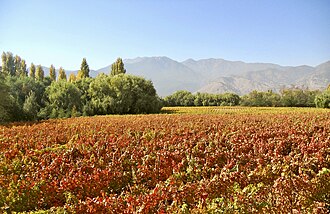
Dry autumn air, crimson leaves, smoky herbs, grilled peppers, soft light and a vineyard that finally had enough time.
Carménère does not hurry into ripeness.
It waits for dry air, long autumn light and the slow turning of green spice into depth.
Contents
Origin & history
A Bordeaux grape with a hidden Chilean afterlife
Carménère comes from Bordeaux, where it once belonged to the wider family of red grapes that shaped the region’s blends. It stood alongside Cabernet Sauvignon, Cabernet Franc, Merlot, Malbec and Petit Verdot, though it never became as reliable as those companions. Its old French name is often linked to crimson colour, and that feels fitting. Carménère can show reddish young growth, autumn leaves that burn with copper and ruby tones, and deeply coloured fruit when the season allows full maturity.
Read more →
The variety’s parentage places it firmly inside the old Cabernet world. Carménère is understood as a natural crossing of Gros Cabernet and Cabernet Franc. This matters because the plant carries clear family signs: dark berries, leafy aromatics, a tendency toward green spice, and a need for real phenolic maturity before its character becomes balanced. It is not simply “like Merlot,” even though it was confused with Merlot for many years. It is a more restless and demanding vine, closer in spirit to the leafy, late-ripening side of the Cabernet family.
In Bordeaux, Carménère was never easy. The Atlantic climate could be too cool, too damp or too uncertain for a grape that ripens late and flowers imperfectly in poor conditions. After phylloxera changed the vineyard landscape of France, growers often preferred more dependable varieties. Carménère survived, but only barely, and for a long time it seemed more like a historic memory than a practical modern grape. Its difficulty nearly erased it from the place where it began.
Chile changed that story. Nineteenth-century cuttings from Bordeaux reached Chile before phylloxera devastated Europe, and among them were vines that growers later believed to be Merlot. For decades, this “Chilean Merlot” ripened later, tasted darker and greener, and behaved differently in the vineyard. In 1994, French ampelographer Jean-Michel Boursiquot identified these vines as Carménère. The grape had not disappeared. It had been hiding in plain sight, waiting for a country whose long, dry autumns suited it far better than Bordeaux ever had.
Ampelography
Broad leaves, dark berries, and a crimson field signature
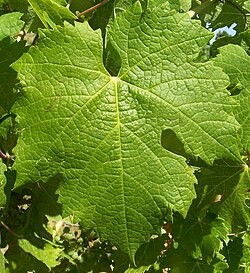
Carménère is not a delicate-looking vine, but its identity is subtle. The leaves are generally medium to large, often broad, sometimes with rounded lobes and a rather full surface. Young shoot tips can show reddish or bronze tones, and the mature canopy may take on striking red colour in autumn. That seasonal colouring gives the vine a visual drama that fits its name: a grape marked by crimson not only in the glass, but in the vineyard itself.
Read more →
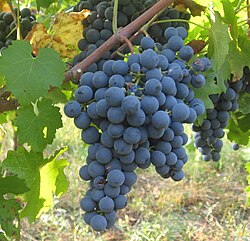
Its clusters are usually medium-sized, sometimes loose to moderately compact, and the berries are dark blue to black at maturity. The grape’s skins give colour and aromatic intensity, yet the tannins can be softer and less severe than Cabernet Sauvignon. This combination is one reason Carménère often feels generous rather than hard when fully ripe. The vine can carry depth without needing the same firm structural frame as its more famous Cabernet relatives.
In the field, Carménère can be difficult to distinguish from related varieties without close observation. Its historical confusion with Merlot in Chile and with Cabernet Franc in parts of Italy shows how easily the vine can hide among its family members. Yet its behaviour gives clues. It ripens late. It often keeps a leafy, peppery aromatic trace longer into the season. Its fruit may lag behind neighbouring Merlot, and its canopy can hold a distinctive reddish cast as the year turns.
- Leaf: medium to large, broad, sometimes rounded, with reddish young growth and crimson autumn tones
- Bunch: medium-sized, loose to moderately compact, depending on clone, flowering and site
- Berry: dark blue-black, capable of deep colour and strong savoury aroma
- Impression: late, dark, leafy, warm-climate sensitive and quietly dramatic
Viticulture
Late ripening, uneven flowering, and the need for patience
Carménère is above all a late-ripening grape. This single fact explains much of its history, its decline in Bordeaux and its success in Chile. It needs a long season not only to accumulate sugar, but to soften its tannins and reduce the more aggressive side of its green, peppery character. In a short or cool season, Carménère may remain tense, vegetal and unfinished. In a long, dry autumn, it can become supple, dark and complete.
Read more →
The vine is also known for problems with fruit set. Coulure can reduce yields when flowering weather is poor, especially in cool, wet or unsettled conditions. This makes Carménère less dependable than Merlot and one reason it became unattractive to growers who needed consistent production. A vine that flowers irregularly and ripens late asks more from both climate and grower. It is not a practical grape for every vineyard, however romantic its story may be.
Canopy management is central. Too much shade can preserve methoxypyrazine-driven green notes, making fruit smell strongly of bell pepper, raw herbs or jalapeño. Too much sun, however, can stress the fruit, reduce freshness or push ripeness toward heaviness. Carménère needs a careful balance: enough exposure for maturity, enough leaf cover for protection, enough airflow for health, and enough patience to avoid harvesting before the variety has settled into itself.
Warm, dry sites with moderate vigour suit the grape best. Fertile soils can produce leafy growth and dilute fruit, while overly hot conditions can turn softness into heaviness. The best vineyards tend to let Carménère ripen slowly under generous light, often with cool nights or mountain influence to preserve shape. The grower is always trying to guide the vine from green to ripe without losing its savoury nerve. That is the viticultural heart of Carménère.
Wine styles
A grape whose flavour begins in the vineyard
Although Carménère is usually discussed through wine, its flavour identity begins very clearly in the plant. The grape is naturally rich in leafy, peppery compounds that can be beautiful when ripe and severe when immature. Its best-known markers — black fruit, roasted pepper, tobacco leaf, green peppercorn, cocoa and smoke — are not simply winemaking choices. They are the sensory result of a late-ripening vine finally reaching balance.
Read more →
In fully ripe fruit, Carménère tends toward dark plum, blackberry, black cherry, blueberry skin and savoury spice. Its tannins are often rounder and less forceful than Cabernet Sauvignon, while its colour can be deep and staining. The grape rarely feels as bright as Cabernet Franc or as immediately plush as Merlot. It sits somewhere between: darker than Merlot, softer than Cabernet Sauvignon, greener and more aromatic than many warm-climate red grapes.
This makes harvest timing crucial. If picked too early, the wine can taste dominated by raw capsicum, grass, stems or sharp herbal notes. If picked too late, the fruit may become heavy and the natural freshness may fade. The most successful Carménère often keeps a savoury green line, but surrounds it with ripe black fruit and calm texture. The aim is not to erase the green note entirely. The aim is to let it become seasoning rather than the main dish.
As a varietal wine, Carménère often shows its most recognizable personality. In blends, especially with Cabernet Sauvignon or Merlot, it can add colour, softness, mid-palate richness and aromatic spice. Yet even then, the grape’s vineyard nature remains visible. Carménère is never a neutral supporting actor. It brings a warm, dark, leafy signature that marks the wine with the memory of its long season.
Terroir
Long autumns, dry valleys, and slow maturity
Carménère’s ideal terroir is warm, dry and patient. It does not simply need heat; it needs a season long enough for the grape to move from green structure to ripe savoury depth. Chile’s central valleys offer this with unusual clarity: bright days, low disease pressure, dry autumns, mountain influence and many sites where ripening can continue late without the constant danger of rain. This is why the grape found such a persuasive second home there.
Read more →
In Colchagua, Carménère can become broad, dark and generous, especially where sun and drainage are well balanced. Cachapoal and Peumo are often associated with some of the grape’s most polished Chilean expressions, combining ripeness with savoury detail. Maipo can bring firmer structure and a more Cabernet-like frame, while Maule and Curicó add further variation, from warmer valley-floor expressions to older, more rustic vineyard material.
Soil and water matter greatly. Carménère benefits from well-drained soils that reduce excessive vigour and help berries ripen evenly. Alluvial soils, gravel, clay-loam and colluvial slopes can all work when the balance is right. Too much fertility creates shade and leafy growth. Too little water in a hot site can stress the vine and make ripening uneven. The most successful vineyards allow the vine to struggle just enough to concentrate its fruit, but not so much that maturity becomes blocked.
Outside Chile, Carménère remains more selective. It can be found in Italy, especially in the northeast, where some plantings were historically confused with Cabernet Franc. In China, the name Cabernet Gernischt is often discussed in relation to Carménère, though identification and local usage can be complex. Smaller plantings also exist in Argentina, California, Washington and elsewhere. Yet the pattern is clear: the grape travels, but it only truly opens where warmth, dryness and time come together.
History
From near-oblivion to national signature
The history of Carménère is one of the most memorable stories in grape culture. It was not simply exported, planted and celebrated. It was misread, almost lost, preserved under another name and later recovered. That makes it different from many famous varieties. Carménère’s identity had to be found again. Its modern importance begins not with fame, but with confusion.
Read more →
In Chile, the grape was long part of vineyards labelled or understood as Merlot. Growers noticed that some vines behaved differently, ripened later and gave wines with a darker, more herbal profile. But without modern identification, these differences were often accepted as local variation. When the true identity was recognized in the 1990s, Carménère gave Chile something rare: not merely another international grape, but a variety with a dramatic story and a strong sense of national belonging.
At first, the rediscovery story may have been more famous than the viticulture. “The lost grape of Bordeaux” is an irresistible phrase. But the real work came afterwards. Chilean growers had to understand which sites suited Carménère, how much leaf exposure it needed, when to harvest, how to manage its green character and how to avoid both underripeness and heaviness. The grape became a national signature only through decades of observation and correction.
This is why Carménère is so valuable for a grape library. It shows that a variety is not fixed in one place or one era. A grape can fail in its homeland, survive abroad, be misunderstood for generations and then return to the world with new meaning. Its history is not tidy, but it is alive. Carménère reminds us that viticulture is full of hidden identities, old migrations and second chances.
Pairing
A natural match for smoke, herbs and warmth
Carménère’s table personality follows the grape’s vineyard personality. It is soft enough for generous food, dark enough for grilled meat, and savoury enough for herbs, peppers, mushrooms and smoke. Because the variety often carries green peppercorn, roasted capsicum, tobacco leaf and cocoa-like depth, it works beautifully with dishes that have char, warmth or earthy sweetness.
Read more →
Aromas and flavors: blackberry, plum, black cherry, blueberry skin, green peppercorn, roasted red pepper, tobacco leaf, bay leaf, cocoa, smoke, cedar and warm earth. Structure: usually medium to full-bodied, often deep in colour, with rounded tannins and moderate freshness when grown in balanced sites.
Food pairings: grilled beef, lamb, pork shoulder, empanadas, roasted peppers, mushrooms, black beans, lentils, smoky aubergine, hard cheeses, mild chilli, barbecue, paprika-led dishes and herb-roasted vegetables. It is especially good where sweetness from roasting or grilling meets savoury spice.
The pairing logic is simple: echo the grape’s dark fruit with caramelized food, and echo its herbal edge with peppers, rosemary, bay, cumin, smoked paprika or char. Carménère rarely asks for very delicate cuisine. It prefers food with texture, warmth and a little rustic generosity. That makes it one of the more relaxed and useful red grapes at the table.
Where it grows
Chile at the centre, Bordeaux in the background
Carménère now grows most importantly in Chile. The central valleys are its modern heart, especially Colchagua, Cachapoal, Peumo, Rapel, Maipo, Maule and Curicó. These areas give the vine what it struggled to find in Bordeaux: a long growing season, warm days, dry autumn weather and enough time for late maturity. France remains the origin, but Chile is the country that turned Carménère into a living modern grape again.
Read more →
Chile’s relationship with Carménère is not one-dimensional. Colchagua often gives richness and broad dark fruit. Cachapoal and Peumo are prized for depth, polish and fine savoury detail. Maipo can contribute structure and a more classical Bordeaux-family feel. Maule and Curicó broaden the range, especially where older vineyards or warmer inland conditions shape the grape differently. Even within Chile, Carménère is not one thing; it is a vine that changes with valley, soil, exposure and harvest date.
- Chile: Colchagua, Cachapoal, Peumo, Rapel, Maipo, Maule, Curicó, Aconcagua and other Central Valley sites
- France: Bordeaux origin; now rare but historically important
- Italy: Veneto and Friuli-Venezia Giulia, including plantings once confused with Cabernet Franc
- China: often linked with Cabernet Gernischt, though local naming and identification can be complex
- Elsewhere: Argentina, California, Washington and other small experimental plantings
Why it matters
Why Carménère matters on Ampelique
Carménère matters on Ampelique because it shows how much story can live inside one grape variety. It is a plant with parentage, migration, confusion, near-loss, rediscovery and national identity written into its vineyard life. It teaches that grape varieties are not only flavour categories. They are biological histories moving through place and time.
Read more →
It is also a superb grape for explaining viticulture. With Carménère, almost everything comes back to the vineyard: late ripening, fruit set, canopy shade, pyrazines, harvest timing, soil vigour and site warmth. The difference between raw greenness and beautiful savoury depth is not abstract. It is created in the field, week by week, through the slow negotiation between vine, weather and grower.
For readers, Carménère is immediately memorable. It has a dramatic biography and a clear sensory profile. But beneath that accessibility lies real complexity. It connects Bordeaux and Chile, old genetics and modern identity, ampelography and marketing, vineyard difficulty and national pride. Few varieties make the link between plant science and wine culture so visible.
For Ampelique, Carménère is therefore essential. It reminds us that some grapes are not famous because they were always dominant, but because they survived. It is a variety with scars, disguise and return. A grape that almost vanished from its origin, only to become a signature somewhere else, deserves a place in any serious map of the world’s vines.
Quick facts
- Color: red
- Main names: Carménère, Carmenere, Grande Vidure; sometimes linked with Cabernet Gernischt in China
- Parentage: Gros Cabernet × Cabernet Franc
- Origin: Bordeaux, France
- Modern home: Chile, especially the Central Valley and its warmer, dry subregions
- Most common regions: Chile: Colchagua, Cachapoal, Peumo, Rapel, Maipo, Maule, Curicó and Aconcagua; also smaller or complex plantings in France, Italy, China, Argentina and the United States
- Climate: warm, dry, long-season sites; needs extended autumn ripening
- Viticulture: late ripening, sensitive to coulure, prone to green flavours if harvested too early
- Soils: well-drained alluvial, gravelly, clay-loam and colluvial soils that moderate vigour
- Signature: dark fruit, deep colour, soft tannin, leafy spice and a remarkable rediscovery story
Closing note
A great Carménère is never only dark and smooth. It is the result of a vine that needed time, a season that stayed dry, a canopy that let in just enough light, and a grower who knew not to hurry. Its beauty lies in that slow transformation: from green edge to savoury depth, from mistaken identity to unmistakable character.
Image credits
Carménère leaf image: Wikimedia Commons – Agne27
Carménère vineyard image: Wikimedia Commons – FRPGCHILE.
Carménère cluster image: Wikimedia Commons – Lebowskyclone.
If you like this grape
If you appreciate Carménère’s dark fruit, soft tannins and savoury green spice, you might also enjoy Merlot for its plushness, Cabernet Franc for its leafy perfume, or Malbec for another dark red grape with South American strength and generous texture.
A lost Bordeaux grape, found again in Chile — late, dark, leafy and full of second life.
 Ampelique
Leave a comment