Ampelique Grape Profile
Merlot
Origin, viticulture, morphology, wine styles, and place.
A world classic dark grape of Bordeaux origin, celebrated for suppleness, plush fruit, and its ability to bring generosity without losing seriousness: Merlot can be silky and immediate, deep and age-worthy, plummy and velvety, or mineral, cool, and quietly austere. At its best it is not merely soft. It is one of the great grapes of texture, balance, and human warmth in wine.
Merlot is one of the most misunderstood noble grapes. Its accessibility made it globally famous, and that same accessibility sometimes caused people to underestimate it. Yet in the best sites and in the best hands, Merlot can be as profound as any classical red variety: tender but not weak, rich but not lazy, generous without ever needing to shout.
Merlot is velvet in motion: generous, supple, and quietly luminous, turning ripe fruit, soft tannin, and warmth into effortless grace.
Contents
Origin & history
A Bordeaux original that taught the world how softness can still be noble
Merlot belongs historically to Bordeaux, and more specifically to the right bank and to the cooler, clay-rich or moisture-retentive sites where its early-ripening character can become an advantage rather than a risk. If Cabernet Sauvignon is the emblematic spine of the Médoc, Merlot is the emotional center of places such as Saint-Émilion and Pomerol. There it became capable of wines that are broad without being loose, plush without being careless, and deeply age-worthy without needing to arrive in the sternest possible form.
Read more →
Modern DNA work has shown that Merlot is the offspring of Cabernet Franc and Magdeleine Noire des Charentes. That lineage is revealing. Cabernet Franc contributes aromatic intelligence and structural finesse, while the second parent ties Merlot to older southwestern French vine history. Merlot’s identity is therefore not accidental. It emerges from a family network deeply woven into the classical heart of French viticulture.
Historically, Merlot did not gain prestige because it was loud. It gained prestige because it could make Bordeaux more complete. In blends it supplied flesh, fruit, softness, and early accessibility where Cabernet Sauvignon could be hard or unyielding in youth. On the right bank it demonstrated that it did not need Cabernet to achieve nobility. On the best clay and limestone sites, it could carry an entire wine on its own terms.
Its later global journey, particularly to Italy, California, Chile, Washington State, and many other regions, would turn Merlot into an international name. But that fame often obscured the grape’s real history. Merlot is not simply a soft, easy red. It is one of the classic varieties through which Bordeaux learned to balance firmness with grace.
Ampelography
A dark-fruited vine with generous flesh and early ripening character
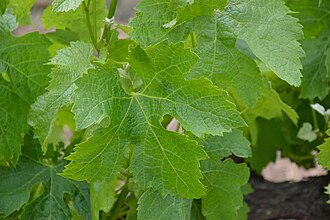
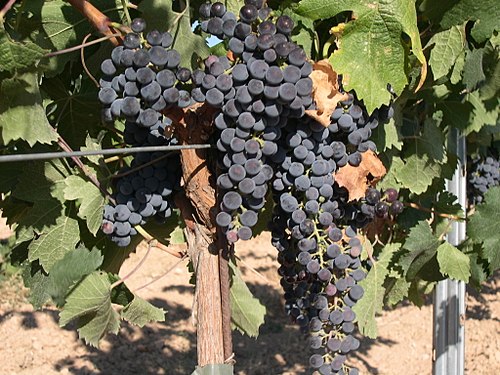
Merlot typically produces medium-sized bunches and berries with relatively thin skins compared with more structurally severe red grapes such as Cabernet Sauvignon. The berries tend toward generous pulp and early sugar accumulation, helping explain why the wines often feel softer and more open in youth. The leaves are structured but not severe, and the vineyard impression is often one of readiness rather than resistance. Merlot looks, in a way, like a grape inclined toward giving.
Read more →
That generosity, however, should not be mistaken for weakness. Merlot’s thinner skins and fuller pulp help explain its textural accessibility, but in top sites the grape still develops enough structure, color, and phenolic depth to age beautifully. It simply builds that depth in a different manner. Merlot does not usually assert itself through the strictest tannin line. It asserts itself through volume, dark red and black fruit, and a broad middle palate that gives wines their signature caressing shape.
This morphology also creates certain viticultural vulnerabilities. Merlot’s early character and fruit shape can make it sensitive to rot pressure and to vintage variation around flowering and ripening. In other words, the same physical attributes that help it become generous in the glass can make it more exposed in the vineyard. This tension — between softness of effect and difficulty of growing — is part of the grape’s deeper personality.
- Leaf: medium-sized, structured but not severe
- Bunch: medium, reasonably full
- Berry: medium, dark, relatively pulpy
- Impression: ripe, generous, textural, early in temperament
Viticulture
An early-ripening grape that thrives where generosity meets control
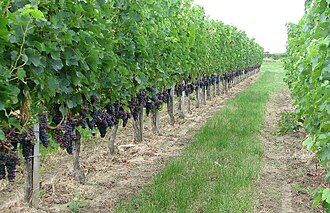
Merlot ripens earlier than Cabernet Sauvignon, and that fact lies at the center of its historic success. In cooler or wetter sites where Cabernet may struggle to reach complete maturity, Merlot can finish more reliably, giving plush fruit and softer tannins. This is why it became so important on Bordeaux’s right bank and in many temperate regions around the world. Early ripening is not just a convenience. It is the key to the grape’s broad adaptability.
Read more →
At its best, however, Merlot still needs a disciplined site. Clay-rich soils are especially important in some of its noblest expressions because they retain moisture and moderate ripening, allowing the grape to develop depth without stress or shriveling. Limestone can add lift and firmness. Gravel or warmer sites may push the fruit profile darker and softer, but without enough freshness Merlot can lose distinction and become merely plush. This is why the best Merlot is not simply ripe. It is ripe with contour.
Viticultural challenges remain real. Merlot can be sensitive to frost because of its early cycle, and it may also be vulnerable to coulure, mildew, or rot under the wrong conditions. Crop load matters. Overcropped Merlot can become dilute at the center, with softness but little real character. The grape needs enough concentration to keep its plushness from turning into vagueness.
The grower’s task, then, is a subtle one: preserve the grape’s natural charm while preventing it from becoming soft, overripe, or anonymous. Merlot’s highest achievements come not from excess, but from managed tenderness.
Wine styles
From plum and velvet to graphite, truffle, and dark floral depth
Merlot’s classic aromatic range includes plum, black cherry, red currant, blackberry, cocoa, cedar, tobacco, violet, bay leaf, damp earth, and in mature or high-quality examples often truffle or graphite-like nuance. What distinguishes Merlot from many other dark grapes is not only what it smells like, but how it moves across the palate. Merlot is often a grape of curve and breadth rather than line and severity. It can seem to arrive from the center outward, coating the mouth with dark fruit and fine texture before tannins announce themselves.
Read more →
In cooler or more restrained contexts, Merlot can show redder fruits, fine herbs, graphite, and a firmer mineral edge than its reputation might suggest. In warmer climates it may deepen toward richer plum, dark chocolate, mocha, and softer, sweeter fruit expression. Oak can add polish, cedar, vanilla, and spice, but because Merlot is already naturally plush, too much new wood can flatten its inner detail rather than enrich it.
Blending remains central to the grape’s history. In Bordeaux it often works alongside Cabernet Franc and Cabernet Sauvignon, adding roundness and generosity. But some of the world’s most moving Merlots are varietal or nearly varietal, especially on the right bank. There, Merlot proves that softness can carry greatness when supported by site, discipline, and age-worthy balance.
With maturity, Merlot can become deeply persuasive. The fruit turns from fresh plum and cherry toward dried fruit, tobacco, forest floor, leather, truffle, cocoa, and cedar. The texture softens but ideally retains shape. Great old Merlot does not merely become easier. It becomes deeper, quieter, and more complete.
Terroir
A grape whose softness changes dramatically with soil and climate
Merlot is often described as soft, but that softness is not uniform. Soil and climate transform it profoundly. On the clay-rich plateaus of Pomerol, Merlot can become dark, velvety, almost enveloping, with a density that still feels poised. On limestone in Saint-Émilion, it may gain more lift, mineral tension, and floral detail. In warmer New World settings it can become richer, rounder, and more open. In cooler or more restrained climates it may show fine red and black fruit, graphite, and a firmer frame than many expect.
Read more →
This is why Merlot should never be reduced to a generic style of soft red. The grape responds to water balance, soil temperature, and ripening conditions with considerable sensitivity. A water-retentive clay can slow and steady its development, helping preserve depth and seriousness. Too much warmth or too fertile a site can make the grape too easy, too quickly, with plushness arriving before complexity.
What terroir often changes in Merlot is not merely flavor, but density and grain. Some sites give silky breadth. Others give chalky lift. Others again produce broad, warm-fruited generosity. Merlot therefore teaches an important lesson: texture itself can be terroir-driven. The grape’s reputation for softness should not blind us to how differently that softness can feel from place to place.
The finest sites make Merlot not simpler, but more articulate. They reveal that generosity can still have direction. This is part of the grape’s nobility and one of the reasons it remains indispensable to serious wine culture.
History
Prestige, popularity, backlash, and rehabilitation
Few noble grapes have experienced modern reputation swings as dramatic as Merlot’s. It was once prized internationally as a way to achieve softness, ripeness, and immediate appeal in red wine. Plantings expanded rapidly in many countries, and the grape became deeply familiar to consumers. That familiarity, however, produced its own danger. When a grape becomes associated with easy drinking and broad market recognition, it can begin to lose prestige even while remaining commercially successful.
Read more →
That is, in many ways, what happened. Large volumes of simple, soft Merlot made the grape seem less interesting than it really was. Popular culture amplified this simplification. Yet the best Merlots — especially from Pomerol, Saint-Émilion, and a handful of exceptional global sites — never ceased to demonstrate the grape’s capacity for greatness. They simply operated at a quieter register than more obviously stern or prestigious varieties.
In recent years Merlot has undergone a kind of rehabilitation. As wine lovers become more attentive to texture, site, and the nuances of right-bank Bordeaux, the grape’s finer qualities have re-emerged. Better site selection, less exaggerated winemaking, and a renewed respect for balance have all helped. The best modern Merlot no longer needs to apologize for charm. It simply proves that charm can coexist with depth.
That makes Merlot historically important in a broader sense. It teaches how fashion can distort perception, and how true quality eventually resists simplification. Great Merlot survived its own overfamiliarity. That is not a small achievement.
Pairing
A red for comfort, earth, and polished savory depth
Merlot is one of the most naturally companionable fine red wines at the table. Because its tannins are often softer and its fruit more rounded than those of Cabernet Sauvignon, it works beautifully with dishes that favor tenderness, earthiness, and moderate richness rather than aggressive char. Roast duck, veal, pork, mushroom dishes, lentils, truffle accents, and sauces with savory depth all sit naturally within Merlot’s world.
Read more →
Aromas and flavors: plum, black cherry, red currant, blackberry, violet, tobacco, cocoa, cedar, bay leaf, earth, and with age often truffle and leather. Structure: medium to full body, moderate tannin, plush fruit core, and a palate shaped more by texture and breadth than by strict tannic severity.
Food pairings: roast chicken with mushrooms, duck breast, veal, pork loin, beef stew, lentil dishes, truffle pasta, hard and semi-hard cheeses, and savory vegetarian preparations with depth. Firmer, cooler-climate Merlots can also take on grilled meats more confidently, while richer and rounder styles are especially at ease with sauces, roasted roots, and dishes where softness and umami matter more than smoke.
What Merlot offers at the table is not dramatic contrast, but easeful intelligence. It tends to make food feel more complete, more settled, and more human. That is a quieter gift than spectacle, but often a more lasting one.
Where it grows
A global red with a distinctly Bordeaux heart
Merlot now grows across most of the serious wine world. France remains the great reference, especially Bordeaux. Italy has embraced it in many regions, including Tuscany. California and Washington State have produced notable versions, from plush to site-conscious. Chile has long relied on Merlot and Merlot-adjacent plantings as part of its modern red identity. South Africa, New Zealand, and many other places have shown that the grape’s early-ripening, textural character can be highly adaptable.
Read more →
- France: Bordeaux above all, especially Saint-Émilion and Pomerol
- Italy: Tuscany and additional major regions
- United States: California and Washington State
- Chile: a major modern red grape, though sometimes historically confused with Carmenère in old plantings
- Elsewhere: South Africa, New Zealand, Argentina, and many additional wine regions
Its success across so many countries comes from a combination of early ripening, stylistic charm, and adaptability. But the best Merlots, wherever they are grown, still tend to show one essential lesson from Bordeaux: softness becomes noble only when it is held inside real structure.
Why it matters
Why Merlot matters on Ampelique
Merlot matters on Ampelique because it corrects an important misconception in wine culture: that softness and accessibility are somehow opposed to greatness. Merlot shows that this is false. A grape can be generous, charming, and immediately persuasive while still carrying immense complexity, terroir expression, and age-worthiness. In fact, one of Merlot’s great achievements is precisely that it humanizes nobility. It makes greatness feel more touchable.
Read more →
It also helps readers understand the full spectrum of Bordeaux. Without Merlot, Bordeaux becomes a partial story told only through structure and Cabernet-driven prestige. Merlot restores the other half: clay, right bank, tenderness, breadth, and wines whose authority comes not from severity but from complete integration. That broader view is essential to any serious grape library.
For Ampelique, Merlot is equally valuable because its modern reputation is layered and contradictory. It is famous and underestimated, global and local, easy to recognize yet often poorly understood. Those tensions make it fertile ground for exactly the kind of nuanced work a grape platform should do: moving beyond shorthand toward a fuller, more accurate, more beautiful understanding.
Merlot deserves world-class status not because it is common, but because in its highest form it is unforgettable. It reminds us that grace can be profound, and that some of the greatest wines persuade not through hardness, but through trust.
Quick facts
- Color: Black
- Origin: Bordeaux, France
- Parentage: Cabernet Franc × Magdeleine Noire des Charentes
- Climate: moderate, often favorable in cooler or clay-rich sites
- Soils: clay, limestone, mixed right-bank terroirs, and many global equivalents
- Styles: plush, supple, structured, age-worthy, blended or varietal
- Signature: plum, velvet, breadth, right-bank nobility
- Classic markers: black cherry, plum, cocoa, violet, tobacco, truffle with age
Closing note
A great Merlot is never only soft. It is softness given gravity — plum and velvet steadied by earth, mineral memory, and the quiet structure of a noble site.
Image credits
Leaf/detail image: Wikimedia Commons – Marianne Casamance
Vineyard landscape image: Wikikedia Commons – michael clarke stuff
Merlot cluster image: Wikimedia Commons – David Carrero Fernández-Baillo
A world classic, and one of red wine’s finest lessons in how tenderness can still carry depth.
 Ampelique
Leave a comment