Ampelique Grape Profile
Sangiovese
Origin, viticulture, morphology, wine styles, and place.
A world classic dark grape of Italian origin, celebrated for vitality, savory depth, and one of the clearest expressions of Mediterranean red-wine character: Sangiovese can be bright and tensile, cherry-scented and earthy, stern in youth and noble with age, but at its best it is always a grape of line, acidity, and place. Few varieties speak so persuasively of hillside light, stone, and food.
Sangiovese is one of the great civilizing grapes of wine. It does not usually overwhelm with sheer color or opulence. Instead, it persuades through energy, fragrance, acidity, and the quiet authority of structure shaped by food and landscape. In the best examples, it feels not merely expressive, but deeply inhabited by Tuscany and by the idea of the table itself.
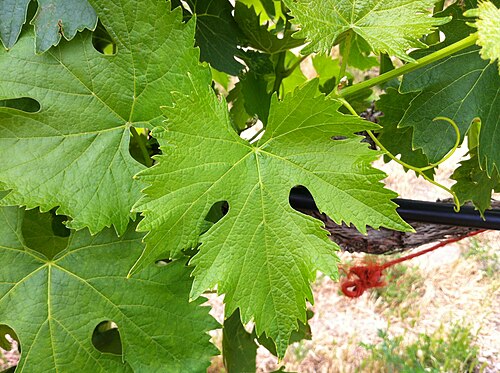
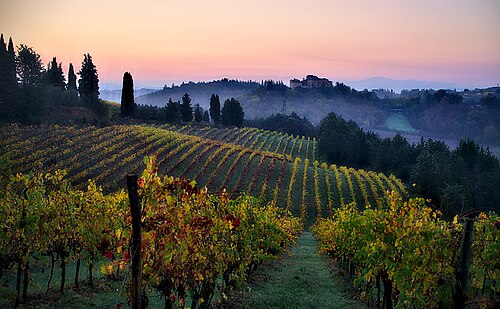
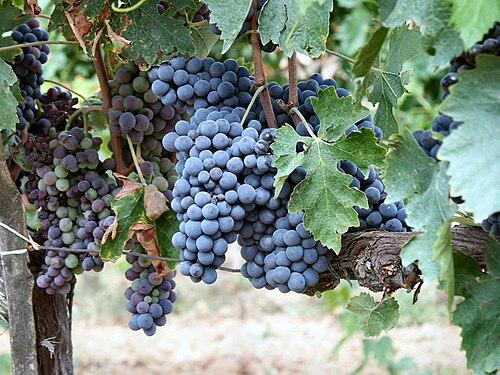
Sangiovese carries sunlight in its own restless way. It turns heat into brightness, earth into contour, and cherry fruit into a voice that feels both tender and severe , as if warmth itself had learned restraint.
Contents
Origin & history
An Italian original that became the voice of Tuscany and beyond
Sangiovese is Italy’s great central red grape, historically rooted above all in Tuscany, where it became inseparable from wines such as Chianti Classico, Brunello di Montalcino, Rosso di Montalcino, Vino Nobile di Montepulciano, and many other regional expressions. It is one of those rare varieties whose cultural importance extends far beyond the vineyard. To speak seriously about Italian red wine is, sooner or later, to speak about Sangiovese.
Read more →
Its exact ancient origins remain less cleanly defined than those of some modern DNA-resolved varieties, though it is unmistakably an old Italian vine with deep roots in central Italy. What matters most in practice is not a single tidy origin story, but the fact that over centuries Sangiovese diversified into local biotypes and became woven into the viticultural language of entire landscapes. It is not just one grape placed in Tuscany. It is one of the grapes through which Tuscany learned to speak.
Historically, Sangiovese was not always treated with the reverence it now enjoys. For long periods it was cropped generously, blended in flexible ways, and asked to serve more practical regional wine culture than high prestige. Yet from that long agricultural life emerged an extraordinary lesson: once yields are controlled, sites respected, and élevage handled with intelligence, Sangiovese can produce wines of tremendous distinction. It did not have to be reinvented so much as listened to more carefully.
That transformation is especially visible in the modern history of Brunello di Montalcino and in the qualitative rise of Chianti Classico. Sangiovese became not merely a regional staple, but a world classic — a grape capable of carrying terroir, tradition, and refinement with unmistakable authority.
Ampelography
A high-toned, medium-built grape with naturally vivid structure
Sangiovese typically produces medium-sized bunches and berries, with skins that are capable of good tannic structure but not usually the deepest possible color. The grape often yields wines that are transparent enough to show ruby brightness rather than opaque darkness, and that visual profile fits its broader identity. Sangiovese is not generally a grape of sheer mass. It is a grape of line, red-toned fruit, and savory movement.
Read more →
Its morphology helps explain why the grape so often balances fruit, acidity, and tannin in a dynamic rather than massive way. Sangiovese rarely feels inert. It usually has some kind of internal motion: sour-cherry brightness, earthy edges, or a mouthwatering acid line that keeps the wine from settling into softness. Even when it becomes richer, as in some Brunellos or warmer-climate expressions, that current of movement remains one of its most identifying traits.
Field variation across clones and local selections is significant, which is part of why Sangiovese appears under different local names and expressions. What remains consistent, however, is the sense that the grape is built more for articulation than for excess. It can absolutely produce powerful wines, but even then they usually retain a kind of angularity or brightness that prevents them from becoming merely broad.
- Leaf: medium-sized, variable across biotypes, classical outline
- Bunch: medium, often reasonably compact
- Berry: medium, structured rather than oversized
- Impression: bright-framed, energetic, shaped by acidity and line
Viticulture
A grape that loves altitude, light, and restraint
Sangiovese needs enough warmth to ripen fully, but it is not a grape that benefits from indiscriminate heat. It often performs best in elevated or hilly sites where sunlight is abundant but nights remain cool enough to preserve freshness and aromatic clarity. This is one reason hillside Tuscany remains so important to its greatness. Altitude, exposure, and poor to moderate soils help prevent the grape from becoming too soft or diffuse.
Read more →
The grape is capable of considerable variation according to site and clone, but one recurring lesson holds: if yields are too high or sites too fertile, Sangiovese can become dilute, sharp, and unconvincing. It needs concentration. Yet if pushed too far toward over-ripeness, it can lose the very tension and savory brightness that make it distinctive. The finest Sangiovese is therefore rarely the ripest. It is the most balanced.
Viticultural sensitivity includes vulnerability to weather around flowering and ripening, as well as the general challenge of aligning sugar maturity with phenolic development. The grape can show acidity before it shows complete harmony, which is why grower judgment matters so much. Sangiovese asks for both patience and precision. It does not reward indifference.
When the site is right and the crop balanced, however, the grape becomes one of the most articulate red varieties in the Mediterranean world. It can hold sunlight without losing freshness, and ripeness without surrendering shape. That equilibrium is at the heart of its nobility.
Wine styles
From sour cherry and herbs to leather, tobacco, and noble earth
Sangiovese’s classic aromatic world includes sour cherry, red cherry, dried herbs, tomato leaf, tea, violet, orange peel, tobacco, cedar, leather, earth, and in mature examples sometimes truffle or forest-floor nuance. But as with all great grapes, a list of aromas is not enough. Sangiovese is defined by movement across the palate: bright entry, savory middle, structured finish. It feels alive in the mouth in a way that many broader reds do not.
Read more →
Chianti Classico often shows Sangiovese in a medium-bodied, vivid, savory register, where acidity and red fruit define the wine’s energy. Brunello di Montalcino, especially from the best sites and vintages, can take the grape toward greater depth, darker fruit, firmer structure, and long ageing potential. Vino Nobile di Montepulciano and other expressions reveal still more local accents. Everywhere the grape remains itself, but the center of gravity shifts — more floral here, more earthy there, more severe in one context, more generous in another.
Winemaking matters, of course. Oak can lend polish, cedar, spice, and breadth. But because Sangiovese already has such a distinctive tension between fruit and acidity, too much oak can flatten the grape’s natural movement. The best producers use élevage to frame rather than obscure. Modern Sangiovese no longer needs to be rough to be authentic, but neither does it need to be smoothed into anonymity.
With age, Sangiovese becomes one of the most civilized of red wines. Cherry turns toward dried fruit and tea; herbs deepen into tobacco and leather; tannins settle; the whole wine becomes less bright in outline but more complete in meaning. Great mature Sangiovese does not abandon freshness. It teaches freshness how to age.
Terroir
A grape that makes hillside Tuscany visible in the glass
Sangiovese is an unusually eloquent terroir grape, though it expresses site not through a single mineral cliché but through tone, tension, and shape. Altitude, galestro, alberese, clay, sand, exposure, and mesoclimate all influence how the grape handles fruit, acidity, and savory depth. A cooler, higher site may yield a more lifted, red-fruited, floral Sangiovese. A warmer, more protected site may bring darker fruit, more body, and deeper earth tones. Yet in both cases the grape’s signature vitality remains one of the clearest threads.
Read more →
This is why Sangiovese differs so clearly across Tuscany itself. The Chianti Classico zone gives one family of expressions, often with nervy acidity and savory brightness. Montalcino, warmer and often broader in amplitude, gives another, with more depth and darker fruit. Montepulciano adds still another dialect. None of these erase the grape’s identity. They reveal its capacity to translate landscape through texture and rhythm.
What terroir most often alters in Sangiovese is the proportion between brightness and gravity. Some sites make it more aerial and red-fruited. Others make it more grounded, earthy, and severe. The best sites maintain the grape’s fundamental liveliness while deepening its center. That equilibrium is what turns Sangiovese from a good food wine into a great wine full stop.
In this sense Sangiovese is one of the great landscape grapes. It does not merely show where it was grown. It shows how that place moved the wine toward brightness, austerity, tenderness, or depth.
History
From rustic reputation to one of Italy’s highest forms of refinement
Sangiovese’s modern history is in many ways the history of Italian fine wine learning to trust its own local grapes more completely. For a long time, many wines based on Sangiovese were shaped by high yields, flexible blending traditions, and a more pragmatic market logic than the prestige model familiar today. This helped create large quantities of honest but not always profound wine. The grape’s nobility was present, but not always fully realized.
Read more →
The qualitative rise of Brunello di Montalcino and the transformation of Chianti Classico were therefore crucial. Better vineyard work, lower yields, more careful clonal understanding, and more precise élevage allowed Sangiovese to show its full depth. At the same time, the Super Tuscan era complicated the picture by blending Sangiovese with international varieties or, in some cases, temporarily overshadowing faith in the grape by suggesting that Bordeaux grapes might lend additional prestige. Yet over time, many producers and drinkers came back to Sangiovese not as a local compromise, but as the true core of Tuscan identity.
This re-centering matters historically. It marked a broader maturation in Italian wine culture — a recognition that international legitimacy did not require imitation. Sangiovese did not need to become something else. It needed its own best conditions. That realization helped restore the grape to its rightful place among the world classics.
Today the best Sangiovese wines show the benefits of that historical confidence. They are no longer defined by apology or by rustic cliché. They are among the finest and most coherent expressions of place in European red wine.
Pairing
A red built for the table, for acidity, and for savory life
Sangiovese is one of the world’s most naturally gastronomic red grapes. Its acidity, moderate body, savory edges, and tannic discipline make it extraordinarily versatile with food, especially dishes built around tomatoes, herbs, olive oil, grilled meat, mushrooms, and aged cheese. It is not a grape that needs luxury to work. It needs honest, flavorful food with enough acidity or umami to meet it halfway.
Read more →
Aromas and flavors: sour cherry, red cherry, dried herbs, tobacco, orange peel, tea leaf, earth, leather, violet, and with age often savory woodland notes. Structure: medium body, vivid acidity, moderate to firm tannin, and a palate driven by energy rather than density.
Food pairings: pasta with ragù, bistecca alla fiorentina, grilled pork, tomato-based dishes, mushroom risotto, hard sheep’s cheeses, roasted vegetables, and herb-driven cuisine. Brunello can take on more serious meat dishes and longer braises. Chianti Classico often shines with food that emphasizes acidity, olive oil, garlic, and fresh herbs. Few red wines are so instinctively at home with their native cuisine.
This table affinity is not incidental. It is one of the core reasons the grape matters. Sangiovese seems to understand that wine is not an isolated object. It is part of a meal, a place, and a rhythm of living. In that sense it is one of the most cultured of grapes.
Where it grows
A global red with an unmistakably Italian center of gravity
Sangiovese grows in many parts of Italy and beyond, but Tuscany remains its spiritual and qualitative center. Chianti Classico, Montalcino, Montepulciano, and a range of Tuscan denominations all offer different interpretations. The grape also appears in Emilia-Romagna, Umbria, Marche, Corsica, and elsewhere. Beyond Italy it has been planted in California, Argentina, Australia, and other regions, sometimes with success, but only selectively does it achieve the same depth of identity it carries in central Italy.
Read more →
- Italy: Tuscany above all — Chianti Classico, Brunello di Montalcino, Vino Nobile di Montepulciano, and many more
- Elsewhere in Italy: Emilia-Romagna, Umbria, Marche, Corsica, and additional regional expressions
- Outside Italy: California, Argentina, Australia, and smaller global plantings
Its international life is real, but its deepest authority still feels Italian. Sangiovese is one of those grapes whose identity is not diluted by global spread, because the home version remains so compelling and so complete.
Why it matters
Why Sangiovese matters on Ampelique
Sangiovese matters on Ampelique because it helps define what a grape library should do at its best: move beyond broad fame toward deeper understanding. Many drinkers know the names Chianti or Brunello, but fewer understand just how distinctive Sangiovese itself is — its acidity, its savory edge, its relation to Tuscan slopes, and its ability to be both everyday and profound. It is a grape through which regional culture becomes legible.
Read more →
It is also a powerful corrective to simplistic prestige hierarchies in wine. Sangiovese is not always the darkest, richest, or softest grape in the room, yet it can produce wines of extraordinary beauty and refinement. It teaches that greatness may lie not in mass but in movement, not in obvious power but in the marriage of acidity, earth, and red fruit. That lesson is indispensable.
For Ampelique, Sangiovese also offers a bridge between viticulture and lived culture. Few grapes feel so naturally connected to food, architecture, hillside farming, and local habit. It is not just a noble variety. It is a civilizational grape — one that helps explain why wine belongs inside a larger human setting rather than standing apart from it.
That is why Sangiovese deserves to stand among the world classics. Not because it imitates the prestige language of other grapes, but because it has its own — brighter, leaner, earthier, and no less profound.
Quick facts
- Color: red
- Origin: central Italy, especially Tuscany
- Climate: moderate to warm, often best on hillsides with elevation
- Soils: galestro, alberese, limestone-clay, and varied Tuscan hillside soils
- Styles: vivid, savory, structured, food-oriented, age-worthy
- Signature: cherry, acidity, herbs, earth, line
- Classic markers: sour cherry, tea, tobacco, orange peel, leather, dried herbs
- Great strength: making brightness feel noble rather than simple
Closing note
A great Sangiovese is never only bright. It is brightness given depth — cherry and herbs held inside earth, stone, and the patient discipline of a cultivated hillside.
Image credits
Leaf/detail image: Wikimedia Commons – Agne27
Vineyard landscape image: Wikikedia Commons – Thomas Fabian
Sangiovese cluster image: Wikimedia Commons – Wind87
A world classic, and one of red wine’s most persuasive reminders that vitality can be as noble as weight.
 Ampelique
Leave a comment