Ampelique Grape Profile
Riesling
Origin, viticulture, morphology, wine styles, and place.
A world classic white grape of Central European origin, celebrated for brilliance, longevity, and one of the clearest expressions of place in wine: Riesling can be dry or sweet, crystalline or deeply textured, floral and citrus-driven or smoky and profound, but at its best it is always a grape of line, tension, and extraordinary transparency. Few varieties translate slope, climate, ripeness, and time with such precision.
Riesling is one of the rare grapes that combines aromatic beauty, structural intelligence, and a near-legendary capacity to age. It can feel weightless and intense at once. It can be delicately floral in youth, stony and smoky in maturity, and in sweet form almost orchestral. For many lovers of white wine, Riesling is not simply one great variety among others. It is the variety that proves just how far white wine can go.
Riesling does not conquer through weight. It persuades through light, acidity, aroma, and a rare ability to make precision feel emotional.
Contents
Origin & history
A Rhine-born classic that became the measure of white wine finesse
Riesling’s historical heart lies in the German-speaking world, especially along the Rhine and Mosel rivers, where cool climates, steep slopes, and complex soils gave rise to one of the most intellectually and emotionally compelling white wine traditions on earth. Its identity is deeply tied to Germany, yet Alsace, Austria, and later Australia, the United States, and other regions also proved that the grape could achieve greatness in different dialects. Still, when people think of Riesling at its deepest, they often return to river valleys, slate, stone, and long cool ripening seasons.
Read more →
Documented references to Riesling in German territories stretch back to the late Middle Ages, and over time the variety became closely associated with fine, age-worthy white wines capable of expressing site with extraordinary precision. Unlike some grapes whose greatness depends heavily on cellar shaping, Riesling earned its status through a combination of natural acidity, aromatic clarity, moderate alcohol potential, and an almost unparalleled ability to hold sugar and freshness in balance. That combination made it useful across dry, off-dry, sweet, and nobly sweet categories — not as an accident, but as a core part of its identity.
Its classical reputation was never merely local. In the nineteenth century, top Rieslings from the Rhine could command prices comparable to, or greater than, many famous Bordeaux wines. This historical prestige is important because it reminds us that Riesling’s current status as a connoisseur’s grape is not a recent invention. It was recognized early as one of the highest forms white wine could take.
What changed over time was not the grape’s intrinsic quality, but the public’s familiarity with sweetness categories, regional labeling, and the subtle ways Riesling expresses itself. It remains one of wine’s greatest paradoxes: universally admired by experts, not always as easily understood by the wider market. Yet that very complexity is part of its greatness.
Ampelography
A fine-skinned vine of delicacy, tension, and precision
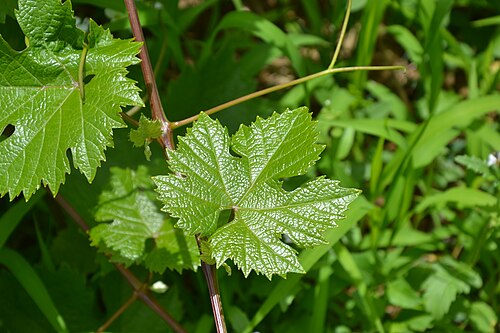
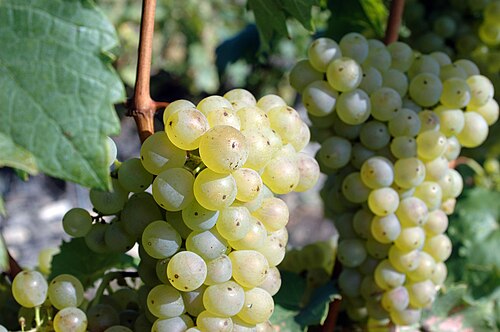
Riesling’s morphology already hints at what it will become in the glass. Bunches are generally small to medium, often compact, with small berries and relatively fine skins. Leaves are usually medium-sized, structured but not coarse, and the vine gives an impression of precision rather than abundance. There is something taut about Riesling even before vinification. It rarely looks extravagant. It looks exact.
Read more →
Those small berries and relatively modest bunches matter because Riesling is a grape of concentration without obvious heaviness. The fruit can accumulate sugar and aromatic detail while still preserving acidity, especially in cool climates. The structure is not built through phenolic force, as with a red grape, but through the relationship between juice, acidity, extract, and ripeness. Riesling’s physical form supports that equilibrium.
Its compact bunches can also create viticultural tension where rot pressure is a risk, but in certain circumstances that same susceptibility becomes part of the grape’s greatness. Riesling is one of the classic noble rot varieties. In other words, what looks like vulnerability can, under the right autumn conditions, become a path toward some of the most profound sweet wines in the world.
- Leaf: medium-sized, tidy, structured
- Bunch: small to medium, often compact
- Berry: small, light green to golden
- Impression: precise, concentrated, delicately built
Viticulture
A late-ripening grape that turns patience into elegance
Riesling ripens late, and that slow development is one of the foundations of its greatness. It thrives in climates where the growing season is long enough for flavor to develop gradually while acidity remains high. In the wrong conditions it may struggle to ripen fully. In the right conditions, the extended season allows aroma, sugar, extract, and acidity to come into extraordinary balance. Riesling is therefore one of the clearest examples of a grape that turns patience into beauty.
Read more →
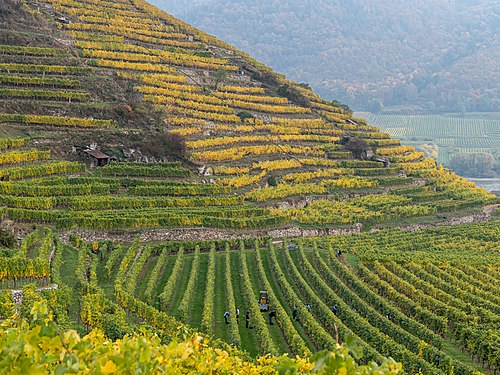
This is why cool river valleys, steep exposures, and sites with reflected light have been so historically favorable. Riesling does not simply need warmth; it needs enough season. Slate, schist, limestone, quartzite, sandstone, and other soils each interact differently with water balance and heat retention, but all great Riesling sites share a certain viticultural logic: they help a late grape finish beautifully in climates that would otherwise be precarious.
Canopy management matters because Riesling can hold acidity and build sugar at the same time, but aromatic purity still depends on healthy fruit and measured exposure. Harvest timing is among the most consequential decisions in all of white winemaking. Pick earlier and the wine may become lime-sharp, floral, and strict. Wait longer and the wine may move toward yellow fruit, deeper extract, and in certain seasons the possibility of botrytis. The grape can produce everything from bone-dry delicacy to nobly sweet profundity precisely because its viticultural pathway remains open longer than many others.
Few grapes reward site discipline so completely. If overcropped, Riesling can lose depth. If harvested carelessly, it can miss its intended form. But where grower judgment is precise, the grape gives one of the most articulate translations of season available in wine.
Wine styles
From bone-dry purity to nobly sweet grandeur
Riesling’s stylistic range is one of the broadest and most intellectually satisfying in wine. It can be bone dry, gently off-dry, fruit-sweet, late-harvest, nobly sweet, and in some contexts even sparkling. This range is not a weakness or a confusion. It is one of the grape’s greatest strengths. Riesling can hold sweetness and acidity together in a way that makes sugar feel architectural rather than clumsy. It can also remain dry while retaining extraordinary aromatic intensity.
Read more →
Young Riesling often shows lime, lemon, green apple, white peach, jasmine, apple blossom, slate dust, and a striking freshness that can feel almost electric. With age it may broaden into quince, beeswax, smoke, spice, dried citrus peel, and the famous petrol note that appears in certain mature examples. That petrol character is much discussed, sometimes exaggerated, but in fine wines it is usually one note among many rather than the whole composition. Great aged Riesling is never merely aromatic curiosity. It is one of the most moving forms white wine can take.
Dry Riesling can be severe, saline, floral, and deeply mineral. Off-dry Riesling often reveals the grape’s balancing genius most clearly, because a touch of sweetness broadens the palate without dulling the acid spine. Sweet and nobly sweet Rieslings, when made from late-harvest or botrytized fruit, can achieve enormous concentration while remaining astonishingly alive. The finest examples taste not sugary, but tension-filled, as though sweetness has been threaded with cold light.
Winemaking for Riesling is often less about shaping through oak and more about preserving detail. Stainless steel, large neutral casks, careful fermentations, and clarity of fruit are more common than overt barrel signatures. Riesling usually does not need embellishment. It needs precision. It is one of the great proofs that transparency can be more profound than adornment.
Terroir
One of the most transparent grapes in the language of place
If Chardonnay is often treated as the great white mirror of terroir, Riesling belongs in the same sentence without hesitation. It is one of the clearest varieties for understanding how slope, exposition, ripening speed, and soil type become visible in wine. Slate, limestone, sandstone, loess, volcanic material, and schist all leave distinct imprints, not in a simplistic one-soil-one-flavor way, but in the way they influence heat, drainage, water retention, and therefore vine behavior.
Read more →
Mosel Riesling on slate can feel feather-light yet intensely mineral, all lime, smoke, and tensile elegance. Rheingau Riesling may come across broader and more architectural. Alsatian Riesling often carries more dry extract, greater body, and a firmer dry identity. Austrian Riesling can show stony energy and compact fruit in a slightly different register again. The grape remains recognizably Riesling in each case, but the accent is unmistakably local.
This transparency is not only geological. It is climatic and temporal. Warm vintages can produce richer, more generous Rieslings with lower apparent acidity and more yellow-fruited expression. Cooler vintages can yield stricter, more citrus-driven wines with sharper mineral edge. The variety is therefore one of the clearest ways to taste vintage, not just site. It records the season without losing varietal identity.
This is why Riesling matters so much to serious wine culture. It is not just delicious. It is explanatory. It helps make visible the usually hidden relationships between site, season, and style. In that sense, it is not only a world classic. It is one of wine’s clearest teachers.
History
Prestige, misunderstanding, and enduring greatness
Riesling has enjoyed enormous prestige, but it has also been repeatedly misunderstood. Part of that misunderstanding comes from sweetness. In an era when many drinkers became accustomed to dry table wines with straightforward labeling, Riesling’s nuanced scale of dryness and ripeness levels often seemed confusing. Yet that complexity is not a flaw in the grape. It is part of its cultural depth. Riesling asks wine lovers to pay attention.
Read more →
There were also periods in which inexpensive, generic wines carrying Germanic labels damaged the public image of a grape whose finest expressions were anything but generic. Riesling suffered from the strange burden of being both one of the highest forms of white wine and, in some markets, a misunderstood supermarket category. That split reputation still affects how the grape is perceived, even though professionals and collectors have long recognized its greatness.
In recent decades, dry Riesling has gained renewed visibility, especially through Germany, Alsace, Austria, Australia, and the United States. At the same time, the world’s finest sweet Rieslings have retained their almost mythical status among those who know them. This dual revival matters because it restores the grape’s full image: not simply sweet or dry, but complete.
Riesling endures because it never depended on fashion alone. It depended on truth — the truth of site, acidity, age-worthiness, and a style logic that rewards patience. Great grapes survive simplification. Riesling has done that repeatedly.
Pairing
A master of tension at the table
Riesling is one of the most versatile food wines in the world because acidity, aroma, and sugar can all be used as tools. Dry Riesling can slice cleanly through seafood, pork, and lightly creamy dishes. Off-dry Riesling can calm heat and spice while preserving freshness. Sweet Riesling can hold blue cheese, fruit desserts, and noble, savory contrasts. Few grapes can move so easily between refinement and generosity at the table.
Read more →
Aromas and flavors: lime, lemon, green apple, white peach, apricot, jasmine, blossom, slate, smoke, beeswax, spice, and with maturity sometimes petrol-like complexity. Structure: high acidity, often moderate alcohol, and a remarkable ability to balance sweetness and freshness with uncommon elegance.
Food pairings: shellfish, trout, pork, sausages, smoked fish, lightly spiced cuisine, Thai dishes with restraint, Chinese cuisine, roast chicken, soft cheeses, blue cheeses, and fruit-based desserts in sweeter styles. Dry Riesling often excels with mineral, saline dishes and fine fish. Off-dry Riesling is among the most useful wines in the world with spicy food because its sweetness and acidity together create harmony instead of conflict.
The finest pairings with Riesling often work because the wine does not simply accompany food — it reorganizes it. Acidity sharpens flavors, sweetness resolves heat, and aromatic lift makes a dish seem more articulate. Riesling is not only versatile. It is transformative.
Where it grows
A global white with a very strong Central European center
Riesling grows in many countries, but it still feels spiritually centered in Germany and the broader Central European wine world. Germany remains the reference point for the full stylistic range. Alsace gives a more powerful, often drier register. Austria offers compact, stony, high-energy versions. Australia, especially Clare and Eden Valley, created a distinct modern tradition of dry, lime-driven Riesling. The United States, especially the Finger Lakes, Washington State, and selected cooler regions, has also shown the grape’s continuing adaptability.
Read more →
- Germany: Mosel, Rheingau, Nahe, Pfalz, Rheinhessen, and many others
- France: Alsace above all
- Austria: Wachau, Kamptal, Kremstal, and more
- Australia: Clare Valley, Eden Valley
- United States: Finger Lakes, Washington State, selected cool sites
- Elsewhere: New Zealand, Canada, and smaller plantings in additional cool-climate regions
Its distribution tells a clear story: Riesling belongs where coolness is not a disadvantage but a resource. It thrives where other grapes may hesitate, and where patience is rewarded more than sheer heat.
Why it matters
Why Riesling matters on Ampelique
Riesling matters on Ampelique because it clarifies so many essential truths about grapes and wine. It shows that a variety can be aromatic without being superficial, sweet without being heavy, dry without being austere, and transparent without being fragile. It is one of the clearest teaching grapes available: a variety through which readers can understand site, climate, sweetness, ageing, and the emotional power of white wine all at once.
Read more →
It also helps correct simplifications. In many wine conversations, red grapes still dominate the prestige narrative. Riesling quietly dismantles that hierarchy. It proves that white wine can age just as nobly, express place just as precisely, and move drinkers just as deeply. In some contexts it may do these things even more clearly, because acidity and aroma can carry nuance with extraordinary speed.
There is also a cultural generosity to Riesling that fits Ampelique well. It can welcome beginners through fragrance and brightness, then reward experts through site detail, classification systems, and ageing complexity. It is at once accessible and inexhaustible. That is rare. Most grapes excel at one of those tasks more than the other. Riesling manages both.
For Ampelique, then, Riesling is not just another famous grape page. It is one of the central pillars of any serious grape library. To understand Riesling is to understand that delicacy can be powerful, that acidity can be beautiful, and that the finest wines do not always persuade through weight. Sometimes they persuade through light.
Quick facts
- Color: white
- Origin: Germany / Rhine world
- Climate: cool to moderate, long-season
- Soils: slate, limestone, sandstone, loess, schist, and more
- Styles: dry, off-dry, sweet, nobly sweet, sometimes sparkling
- Signature: acidity, longevity, transparency, aromatic finesse
- Classic markers: lime, peach, blossom, slate, smoke, petrol with age
- Great strength: balancing sugar and acidity with uncommon grace
Closing note
A great Riesling is never only about fruit or aroma. It is about clarity, slope, season, acidity, and the way a wine can feel both delicate and indestructible. At its best, Riesling tastes like precision made luminous.
Image credits
Leaf/detail image: Wikimedia – Marianne Casamance
Vineyard landscape image: Wikicommons – Isiwal
Chardonnay cluster image: Wikimedia Commons – Bauer Karl
A world classic, and one of white wine’s clearest proofs that light can carry depth.
 Ampelique
Leave a comment