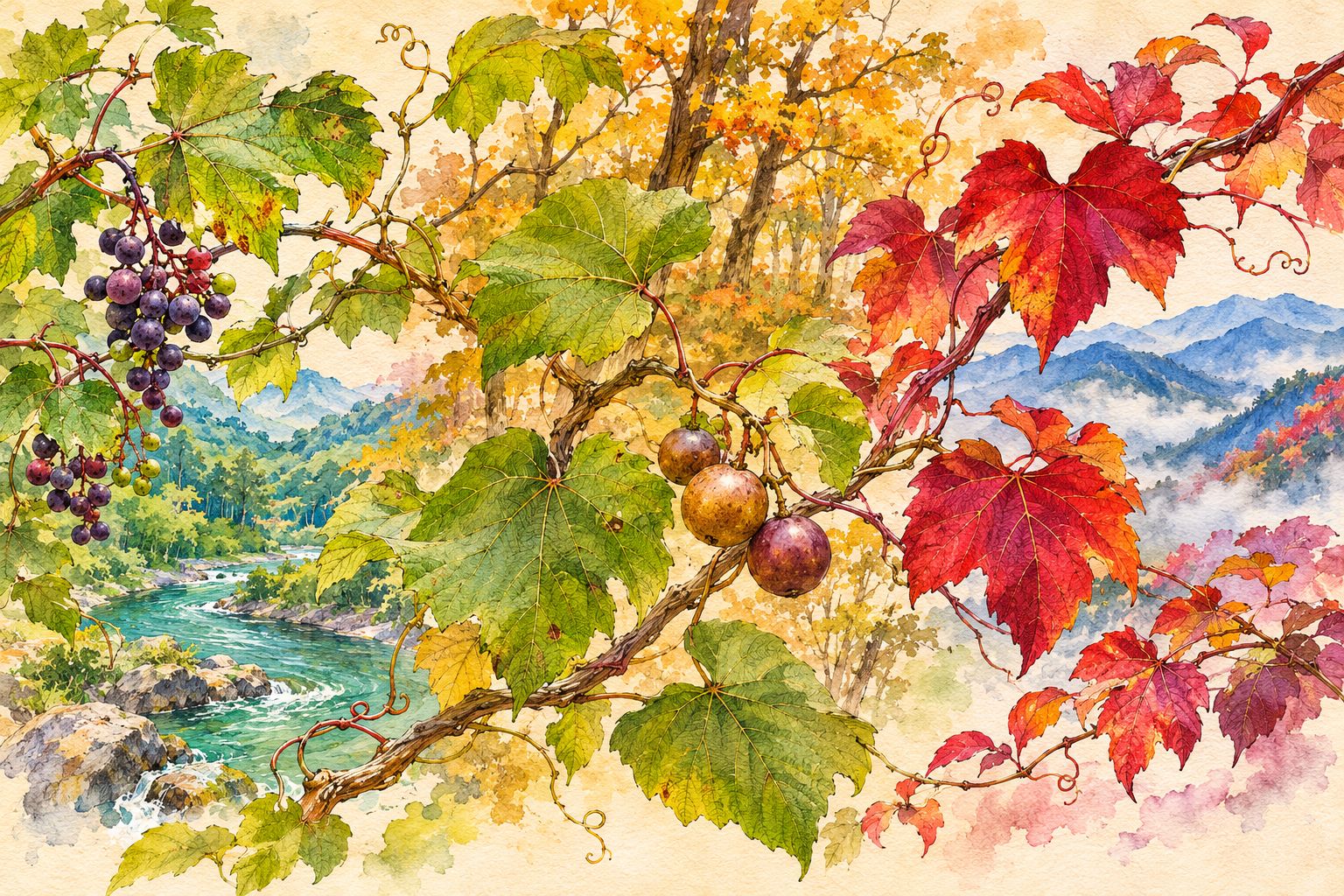
A world of wild grapevines
Pull a bottle of Riesling from the shelf and you have one kind of grapevine in mind. Walk along the Danube and you might find a wild relative climbing into a tree. In the woods of the American South, you could come across a vine with bronze grapes that ripen a few at a time. And in northeast Asia, there are wild vines that can hold their own through a much colder winter than most wine grapes are used to.
They all belong to Vitis, the group of plants we call grapevines. Spend a little time with them and the grapevine starts to look like a much more varied plant than a row of Chardonnay might suggest.
From the wine list to the riverbank
Vitis vinifera is the grapevine most wine drinkers know. Chardonnay, Pinot Noir, Riesling and Cabernet Sauvignon are all varieties of this one species. So are many of the grapes we eat fresh or dry into raisins. A bunch of seedless grapes and a glass of Barolo, made from Nebbiolo, may have little in common at the table, but the vines that produced them belong to the same species.
There’s a wild side to vinifera, too. It goes by the name Vitis vinifera subsp. sylvestris, often shortened to Vitis sylvestris. Its range stretches from western Europe and the Mediterranean into western Asia. In places like the Danube floodplain, it climbs through riverside woodland, where the trees give it something to hold on to.
Its berries are small, dark and often tart. There’s another difference you’d only notice at flowering time. Wild vines usually carry male and female flowers on separate plants. Most cultivated wine grapes have flowers that can pollinate themselves. A wild female vine needs pollen from another plant before it can set fruit.
The grapes behind the jelly jar
In eastern North America, Vitis labrusca brings a different set of flavours to the table. It’s known as the fox grape and is part of the ancestry of Concord, the grape behind much of the purple grape juice and jelly familiar in the United States. Bite into a Concord and the skin slips away from the pulp. The scent is strong enough that you might recognise it before you take a bite.
Head farther south and you come to muscadine country. Muscadines, often listed as Vitis rotundifolia, are at home in the warm, humid southeastern United States. The berries can be bronze or nearly black, with thick skins and sweet, fragrant pulp. They ripen in small groups and can be picked one by one. Scuppernong, an old bronze variety named after a North Carolina river, is one of the best known.
Grapevines that can take the cold
Across the Pacific, Vitis amurensis grows wild in parts of China, Korea and the Russian Far East. Winter hardiness is one of its most useful traits. Grape breeders have drawn on it to develop varieties for places where winter cold can damage more familiar wine grapes.
Another East Asian species, Vitis coignetiae, grows in Japan, Korea and on Sakhalin. In autumn its broad leaves turn deep red. You can see why someone might plant it beside a wall or a pergola and be quite happy to leave the fruit to the birds.
The American roots beneath European vineyards
In the nineteenth century, a tiny insect arrived in Europe on vine material brought from North America. Phylloxera fed on the roots of European wine grapes. Vines weakened and died, and whole vineyards had to be replanted.
Several North American species offered a way forward. Vitis riparia grows along rivers and can cope with cold winters. Vitis rupestris is at home in open, rocky places and roots readily from cuttings. Vitis berlandieri, associated with the limestone country of Texas, brought a trait that mattered in many European vineyards. It could handle lime-rich soils.
Growers grafted their wine varieties onto resistant American rootstocks. Many of those rootstocks were crosses, so they could combine traits suited to different soils and growing conditions. The roots did the work underground, while the part above the graft went on producing its usual grapes.
Next time you walk along a row of vines, look for a small swelling near the base of a trunk. That’s often where the two parts were joined. The grapes above it might be Chardonnay, Riesling or Pinot Noir. Beneath your feet, the vine may owe its roots to a wild grape from a North American riverbank.
Sources & further reading
- Kew Science – Native ranges
- Ecology and Evolution – Wild grapevines in the Danube floodplain. onlinelibrary.wiley.com
- NC State Extension – Concord and Vitis labrusca, muscadines and Scuppernong. content.ces.ncsu.edu
- Wageningen University & Research – Winter hardiness and autumn colour in East Asian grapevines. edepot.wur.nl
- Frontiers in Plant Science – North American grape species and their role in European rootstocks.
Learn more about our research and editorial approach.
Leave a Reply