Understanding Portugal: Wine Heritage, Native Grapes, Regions, and Viticultural Identity
A country of Atlantic light, mountain valleys, schist slopes, granite soils, and one of Europe’s richest native grape cultures: Portugal is one of the most distinctive wine countries in the world, shaped by river valleys, ocean influence, old field blends, dry inland heat, green northern landscapes, fortified traditions, and a remarkable diversity of indigenous varieties. From Vinho Verde and the Douro to Dão, Bairrada, Alentejo, Madeira, and the islands, it offers a wine culture rooted not in imitation, but in local grapes, regional memory, and landscapes that still feel vividly alive in the glass.
Portugal speaks in native grapes, in terraces and granites, in schist and sea air, in old vines that were never asked to become international, only to belong completely to their place.
Overview
Portugal is one of Europe’s most characterful vineyard countries, yet it is often understood too narrowly from the outside. Port and Madeira have long given it international visibility, and in recent decades dry Douro reds, Vinho Verde whites, and the wines of Alentejo and Dão have deepened that picture. But Portugal is not only a country of famous styles. It is a country of indigenous grapes, regionally distinct landscapes, and viticultural continuity that still feels unusually intact.
What makes Portugal so compelling is the way local grape culture continues to matter. Rather than relying mainly on a small set of widely international varieties, Portugal has preserved a large and meaningful native vine heritage. This gives the country a different kind of identity from many other wine-producing nations. The grapes themselves often feel inseparable from the places where they are grown: Alvarinho in the far north, Touriga Nacional in the Douro and Dão, Baga in Bairrada, Encruzado in Dão, Arinto across multiple regions, Castelão around Setúbal, and many others that still carry strong regional resonance.
For Ampelique, Portugal matters because it shows how wine can remain deeply local while still being broad in style. It is a country of Atlantic freshness and inland heat, of green valleys and severe terraces, of fortified traditions and sharply defined dry wines, of island viticulture and continental mountain zones. It is one of the clearest examples of a grape culture built from within rather than standardized from outside.
Climate & geography
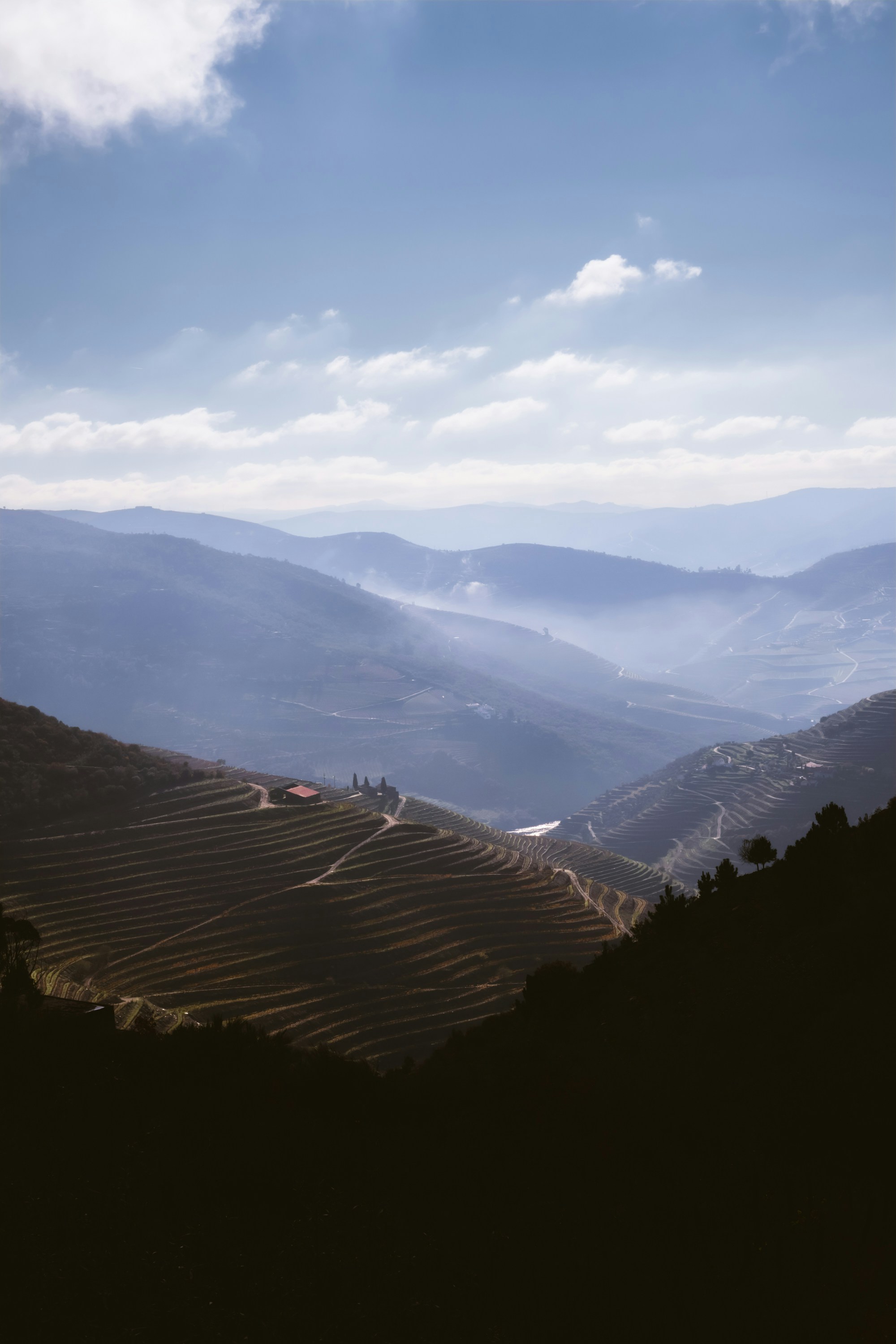
Portugal’s vineyard geography is far more varied than its size might suggest. In the north, Atlantic influence is strong, especially in Vinho Verde, where rainfall, humidity, and green vegetation shape a fresher, cooler viticultural world. Move inland and the Douro Valley becomes warmer, drier, and dramatically terraced, with schist slopes that hold heat and force the vine into a harsher dialogue with the land. In central Portugal, granite, altitude, and forest-moderated conditions define parts of Dão, while Bairrada’s proximity to the Atlantic brings a different balance of freshness and pressure. Farther south, Alentejo opens into a broader, warmer landscape, though not without internal variation in altitude and exposure.
The Atlantic remains a major force in Portugal’s identity, but it is not the whole story. River systems matter greatly, especially the Douro, whose valley has long shaped both fortified and unfortified wine cultures. So do soils: schist in the Douro, granite in Dão, limestone-clay zones in Bairrada, sandy and maritime conditions around parts of Setúbal, and volcanic conditions on Atlantic islands such as Madeira and the Azores. These are not cosmetic differences. They shape acidity, phenolic ripeness, aromatic profile, water retention, and the broader style of the wines.
Portugal is therefore best understood as a series of linked but distinct vineyard environments. The green north does not behave like the Douro. The Douro does not behave like Alentejo. Madeira stands apart again, and the Azores tell yet another island story. This diversity helps explain why Portugal produces such a broad range of wine styles while still feeling unmistakably itself.
Grape heritage
Portugal’s native grape heritage is one of its greatest strengths. Official Wines of Portugal material highlights more than 250 native grape varieties, and that figure alone gives some sense of the country’s ampelographic richness. Yet the value of this diversity is not merely numerical. It lies in the fact that many of these grapes still carry real regional meaning. They are not just entries in a catalog. They remain part of how local landscapes and wine cultures describe themselves.
Touriga Nacional is one of the country’s most important red grapes and is strongly associated with both the Douro and Dão. Touriga Franca, Tinta Roriz, Tinta Barroca, and Tinto Cão continue to matter in the Douro and in Port traditions. Alvarinho is a defining white grape of the far north. Arinto travels across regions with remarkable usefulness, often bringing acidity and minerality. Baga remains central to Bairrada’s stern and age-worthy red identity. Encruzado gives Dão one of its finest white voices. In the south, Aragonez, Trincadeira, and Alicante Bouschet are especially important in Alentejo blends, even though Alicante Bouschet itself is of French origin and has found one of its strongest homes in Portugal.
This is what makes Portugal so fascinating for a grape library. It is not only that many native grapes survive, but that they continue to function as active regional languages. A Portuguese wine often makes more sense once you understand the grapes behind it, and the grapes themselves often make more sense once you understand the valleys, slopes, and climates that still shape them.
Important regions
- Vinho Verde – the green north of Portugal, Atlantic in mood and famous for freshness, especially through Alvarinho and Loureiro.
- Douro – one of Europe’s most dramatic vineyard landscapes, built on schist terraces and central to both Port and great dry wines.
- Dão – a more inland, often granite-influenced region of elegance, where Touriga Nacional and Encruzado are especially significant.
- Bairrada – Atlantic-influenced and historically linked to Baga, with a strong identity for both reds and sparkling wines.
- Alentejo – a broad southern region of warmth, varied subzones, and important red and white blends shaped by native and adapted grapes.
Other regions complete the picture in essential ways: Lisboa and Tejo show how native and international grapes can coexist; Península de Setúbal is strongly associated with Moscatel and Castelão; Madeira stands apart as one of the world’s great fortified island wine cultures; and the Azores offer a singular Atlantic volcanic viticulture. Portugal may be compact, but its wine map is astonishingly layered.
Wine styles
Portugal produces an unusually wide range of wine styles for a relatively small country. Fresh Atlantic whites, structured mountain or valley reds, sparkling wines, dry rosés, oxidative fortified wines, long-lived sweet wines, and field-blend traditions all belong here. The country is especially distinctive in the way it joins table-wine culture to fortified-wine culture without one cancelling the other. Port and Madeira remain globally important, but they exist alongside an increasingly vivid world of dry wines with strong regional identities.
Vinho Verde can be bright, saline, floral, and lightly textured, depending on zone and grape. Douro reds may range from deep and structured to more lifted and mineral. Dão often brings a finer line, with freshness, perfume, and composure. Bairrada can be firm and age-worthy, especially with Baga, while Alentejo may show warmth, generosity, and southern breadth without losing all distinction of place. Madeira, with its unique estufagem and canteiro traditions, stands almost in its own category of wine history.
This breadth is one of Portugal’s most appealing qualities. It allows the country to feel coherent not because all its wines taste alike, but because they remain grounded in native material, local climates, and inherited practice. Portugal does not depend on sameness. Its unity lies in a shared confidence in local character.
Signature grapes
- Touriga Nacional – one of Portugal’s defining red grapes, especially important in the Douro and Dão.
- Alvarinho – a major northern white grape, closely associated with Vinho Verde and especially Monção e Melgaço.
- Arinto – a highly valued Portuguese white grape known for acidity and versatility across several regions.
- Baga – the signature red grape of Bairrada, capable of firm structure and longevity.
- Encruzado – one of Portugal’s most distinguished white grapes, central to the identity of Dão.
- Castelão – an important traditional red grape, especially associated with Península de Setúbal.
Many others deserve equal attention: Loureiro, Fernão Pires, Antão Vaz, Viosinho, Rabigato, Trincadeira, Aragonez, Touriga Franca, Tinta Roriz, Tinto Cão, Alicante Bouschet in Alentejo, and the classic white grapes of Madeira. But these six form a strong first route into Portugal as a country where local grape identity still matters deeply.
Why Portugal matters on Ampelique
Portugal matters because it demonstrates that a country can remain deeply traditional without becoming static. Its vineyard culture is full of continuity, but it does not feel frozen. Native grapes are not museum pieces here. They are active, working parts of regional wine life. Old field blends, local naming traditions, and regionally distinctive viticulture still shape how many Portuguese wines are made and understood.
For Ampelique, Portugal is essential because it offers one of the clearest examples of grape identity rooted in place. It is a country where the vine often still speaks in local terms, where diversity has not been erased, and where geography remains visible in the glass. Portugal reminds us that the grape library is not only a taxonomy of varieties, but also a map of survival, memory, and belonging.
Where to start exploring
If you want to begin exploring Portugal, start with contrast. Read Vinho Verde beside the Douro, Dão beside Alentejo, Bairrada beside Madeira. Compare Atlantic freshness with inland schist warmth, granite refinement with southern breadth, fortified traditions with dry regional wines. Portugal becomes much clearer when you see how strongly climate and geography reshape the local grapes.
You can also begin through varieties. Follow Touriga Nacional into the Douro and Dão, Alvarinho into the far north, Baga into Bairrada, Encruzado into Dão, Arinto across multiple regions, and Castelão into Península de Setúbal. In Portugal, the grape is often the best first guide, but the landscape explains why it matters.
Quick facts for grape geeks
| Field | Details |
|---|---|
| Country | Portugal |
| Continent | Europe |
| Main climate influences | Atlantic, inland continental, Mediterranean, mountain, river-valley, and island influences |
| Key vineyard landscapes | Schist terraces, granite uplands, Atlantic valleys, limestone-clay zones, broad southern plains, volcanic islands |
| Known for | Native grape diversity, Port, Madeira, Vinho Verde, Douro reds, and strong regional wine identities |
| Important grape colors | Both white and red, with major native diversity in each |
| Notable native grapes | Touriga Nacional, Alvarinho, Arinto, Baga, Encruzado, Castelão, Touriga Franca, Tinta Roriz, Loureiro, Fernão Pires |
| International grapes present | Syrah, Chardonnay, Cabernet Sauvignon, Merlot, Sauvignon Blanc, and others in selected regions |
| Best starting point | Begin with Vinho Verde, Douro, Dão, Bairrada, and Alentejo, then move outward to Setúbal, Madeira, the Azores, Lisboa, and Tejo |
 Ampelique