Understanding Greece: Wine Heritage, Native Grapes, Regions, and Viticultural Identity
A country where the vine rises out of mountains, islands, winds, volcanic stone, and one of the oldest continuous wine cultures in Europe: Greece is one of the most distinctive grape landscapes in the world, shaped by altitude, sunlight, sea influence, dry summers, poor soils, old training systems, and an extraordinary wealth of indigenous varieties. From Santorini and Crete to Naoussa, Nemea, Mantinia, Samos, Attica, and the mountain vineyards of the north, it offers a wine culture rooted not in imitation, but in native grapes, local adaptation, and landscapes that still feel deeply present in the wines themselves.
In Greece, the vine is never far from wind, stone, height, salt, memory, or myth. It grows where mountains fall toward the sea and where grapes learned long ago how to endure light, drought, and time.
Overview
Greece is one of Europe’s oldest wine countries, but what makes it compelling today is not only its antiquity. It is the way old viticultural intelligence still feels active in the landscape. This is a country where vineyards do not simply occupy broad easy plains. They climb mountain zones, sit on plateaus, face the sea, bend around islands, and survive in dry and demanding conditions that have forced the vine into a long relationship with adaptation. To understand Greece through wine is therefore to understand not only history, but geography and resilience.
The modern Greek vineyard is especially striking because it remains so deeply tied to indigenous material. White wine production still exceeds red, and the vineyard is heavily planted to native varieties rather than being dominated by a small international set. This gives Greece a different rhythm from many wine countries. The country is not built around one export grape or one dominant stylistic template. Instead, it offers a wide-ranging but coherent world of local cultivars that continue to make sense in their home climates: Assyrtiko on Santorini, Xinomavro in the north, Agiorgitiko in Nemea, Moschofilero in Mantinia, Savatiano in Attica, Vidiano and Liatiko on Crete, Robola on Kefalonia, and many more.
For Ampelique, Greece matters because it shows the grape in a state of deep belonging. The country’s wine identity is not merely regional in an administrative sense. It is ecological, topographical, and cultural. Grapes here often feel inseparable from their landscapes, and the landscapes themselves are unusually legible in the glass: volcanic austerity, mountain freshness, island salinity, plateau aromatics, sun-dried sweetness, and the stern architecture of long-lived northern reds. Greece is one of the places where a grape library can become almost indistinguishable from a map of adaptation.
Climate & geography
Few wine countries combine mountain and maritime influence as fully as Greece. The country is deeply cut by ranges, plateaus, valleys, and coastal exposures, and it is equally defined by its island worlds. This means that viticulture in Greece is rarely uniform. It is shaped by altitude in one place, by sea winds in another, by volcanic ash and pumice in another, by cold winter mountain conditions elsewhere, and by the long, dry, luminous summers that much of the country shares.
Mountain viticulture is especially important. Greece has unusually broad access to elevated sites, and this now matters even more in the age of warming vintages. High-altitude vineyards can preserve acidity, aromatic lift, and longer ripening cycles, particularly in places such as Mantinia, Amyndeon, and parts of Macedonia, Epirus, and the Peloponnese. These are not marginal details. They are one of the structural reasons why Greece can produce white wines of energy and tension in a generally sun-rich climate.
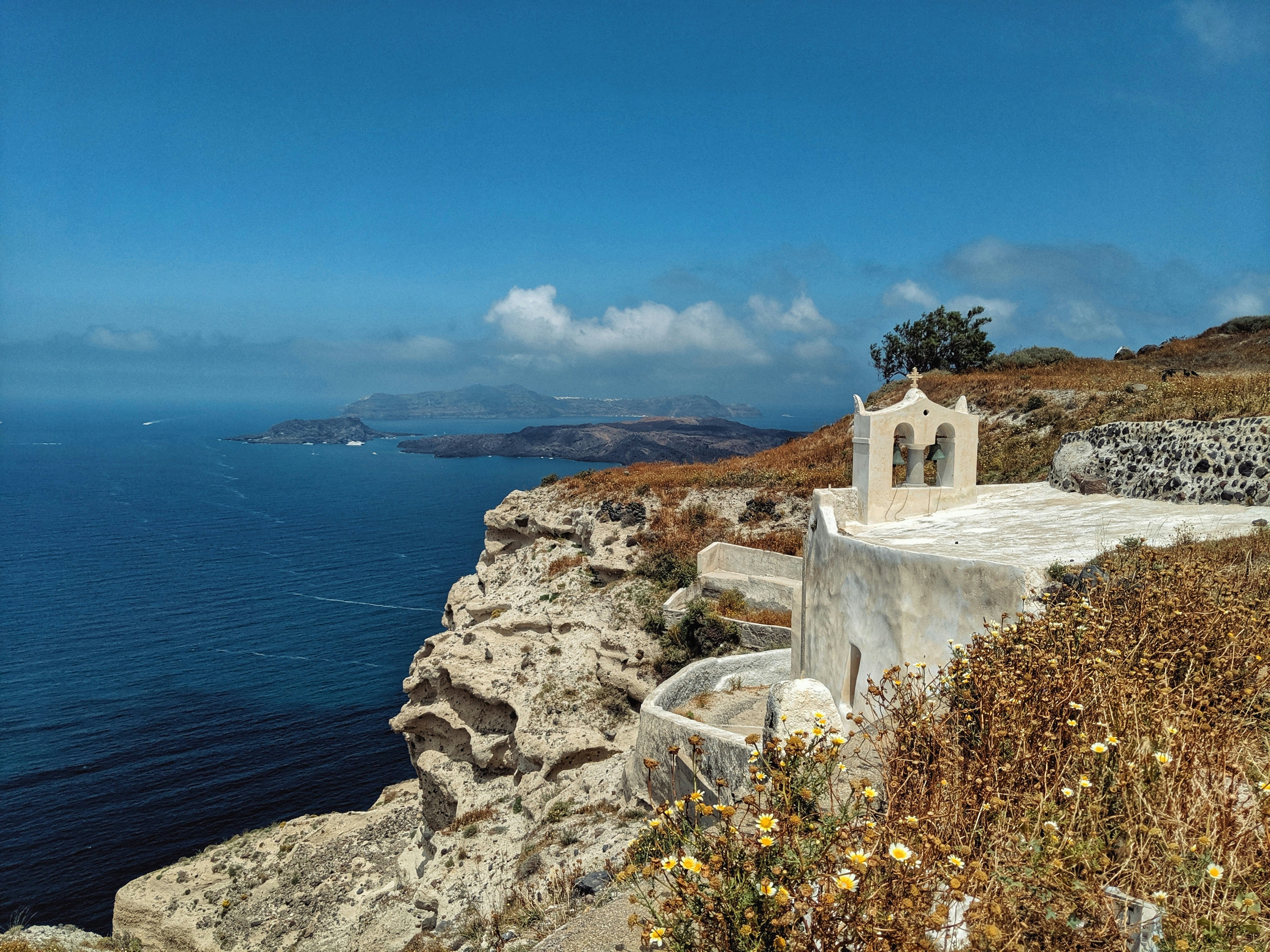
At the same time, island viticulture gives Greece one of its most singular faces. Santorini is the obvious example: a volcanic island with basket-trained vines, extreme wind exposure, poor soils, and some of the most dramatic white wines in the Mediterranean. But the islands extend beyond Santorini alone. Samos, Limnos, Rhodes, Crete, Kefalonia, Paros, and the Ionian and Aegean islands all contribute their own combinations of heat, sea moderation, old vines, and local grape material. Some preserve ungrafted or own-rooted vines, either because phylloxera never arrived or because sandy conditions prevented it from taking hold.
Mainland Greece adds another layer. The Peloponnese contains both warm and elevated viticultural environments. Attica, long associated with Savatiano and one of the country’s largest vineyard areas, lies close to Athens yet still carries a rural vine history of its own. Northern Greece introduces more continental patterns and red-wine depth, particularly through Xinomavro. Crete adds southern latitude but also altitude, wind, and a complex set of indigenous varieties. Greece is therefore best understood as a country of many climates linked by light, drought management, and a long tradition of fitting the right grape to the right hardship.
Grape heritage
Greece’s grape heritage is one of the richest in Europe. Modern trade and promotional material frequently speaks of more than 300 native varieties still scattered across the country, and the broader vineyard remains heavily indigenous in character. This matters because the diversity is not abstract. It is still visibly linked to particular regions and styles.
Assyrtiko is perhaps the most internationally admired of the Greek whites: a grape of Santorini origin that can hold acidity and structure even in hot, dry conditions. Xinomavro is one of Greece’s great red grapes, responsible for some of the country’s most age-worthy and demanding wines in Naoussa, Amyndeon, Goumenissa, and Rapsani. Agiorgitiko defines Nemea and remains one of the country’s most planted red varieties. Moschofilero belongs especially to the high plateau of Mantinia, where it brings rose, citrus, and lifted mountain freshness. Savatiano, long underestimated, remains central in Attica. Malagousia has re-emerged as one of modern Greece’s aromatic white successes. Vidiano, Robola, Liatiko, Limniona, Mavrodaphne, Athiri, Aidani, Roditis, Debina, and many others widen the picture further.
One of the most beautiful things about Greece is that these grapes often feel inseparable from their places. Assyrtiko does not simply happen to grow on Santorini; it seems shaped by it. Xinomavro and Naoussa belong to one another in the imagination of Greek red wine. Agiorgitiko and Nemea are similarly bound. Moschofilero makes its deepest sense on the Mantinia plateau. This means that Greece is not merely a country with many grapes. It is a country where grape and topography still speak in close relation.
For Ampelique, that is invaluable. Greece reminds us that the true measure of a grape heritage is not fame alone, but how vividly the grape still belongs to climate, elevation, soil, food culture, and local continuity. The country’s indigenous material has not only survived. In many places, it has become the central language of modern quality wine.
Important regions
- Santorini – volcanic island viticulture of extreme winds, basket-trained vines, old vineyards, and Assyrtiko-driven whites of tension and mineral force.
- Naoussa – one of northern Greece’s defining red-wine regions, devoted to Xinomavro and known for wines of tannin, acidity, savoury complexity, and longevity.
- Nemea – the great red appellation of the Peloponnese, built around 100% Agiorgitiko and capable of styles ranging from youthful fruit to more structured age-worthy wines.
- Mantinia – a high plateau in Arcadia where Moschofilero produces still and sparkling whites of floral lift, citrus detail, and mountain freshness.
- Crete – a large and varied island wine world where altitude, heat, wind, and native grapes such as Vidiano, Liatiko, Kotsifali, Mandilari, Vilana, and Dafni create a broad spectrum of styles.
These five offer a strong first route into Greece, but they are not the whole map. Samos is essential for Muscat-based sweet wines. Amyndeon is crucial for high-altitude Xinomavro and sparkling potential. Attica matters enormously because of Savatiano and the wider historical importance of the area around Athens. Cephalonia introduces Robola and island limestone. Drama, Thessaly, Epirus, Limnos, Rhodes, and the Ionian islands all extend the picture. Greece is not one famous island and a few northern reds. It is a broad and intricate vineyard country.
That intricacy is exactly why Greece rewards slow reading. Its regions are often not interchangeable, even when they share sunlight or latitude. Height, exposure, sea proximity, and inherited grape material keep pulling them apart into distinct local identities. A Greek wine map is therefore most meaningful when approached as a network of landscapes rather than a list of famous labels.
Wine styles
Greece produces a striking range of wine styles. Dry whites are among the country’s modern strengths, especially those built around Assyrtiko, Malagousia, Moschofilero, Vidiano, Robola, and high-acid mountain or island grapes. But the country is equally important for reds of structure and savoury tension, especially from Xinomavro and Agiorgitiko, and for a continuing sweet-wine tradition that includes sun-dried and fortified forms of real distinction.
Santorini offers some of the Mediterranean’s most severe and long-lived dry whites, often structured more by extract, salt, and acid than by perfume. Mantinia gives aromatic mountain whites of roses and citrus. Naoussa can be pale in color but formidable in tannin and age-worthiness, with flavours that may move from sour cherry and strawberry toward tomato leaf, olive, spice, dried flowers, and earthy complexity. Nemea shows Agiorgitiko’s versatility, from fruit-driven and approachable reds to deeper, more serious expressions. Crete widens the picture through both whites and reds, while Samos and other zones preserve sweet traditions that remain integral rather than secondary.
Greek sparkling wine is also more important than many outsiders assume. Moschofilero in Mantinia and Xinomavro in Amyndeon help show that Greece’s mountain and high-plateau climates can support freshness and precision in sparkling form. Meanwhile, orange or skin-contact approaches, amphora experiments, and contemporary reinterpretations of local varieties continue to appear without replacing the country’s deeper regional identities.
This is one of Greece’s most appealing features: it is not stylistically narrow, but it rarely feels generic. Even when producers innovate, the most convincing wines still tend to make sense through place and grape. Greece can therefore produce saline whites, floral plateau wines, austere volcanic wines, savoury mountain reds, velvety Peloponnesian reds, sweet island wines, and more, while remaining recognizably itself.
Signature grapes
- Assyrtiko – Greece’s iconic white grape of Santorini origin, admired for structure, saline tension, and the rare ability to keep acidity in hot, dry conditions.
- Xinomavro – one of the country’s greatest red grapes, central to Naoussa and other northern appellations, capable of tannin, complexity, and long ageing.
- Agiorgitiko – the defining red grape of Nemea and the most planted red variety in Greece, notable for versatility and regional identity.
- Moschofilero – the aromatic grey-pink grape of Mantinia, known for floral lift, citrus notes, and vibrant plateau freshness.
- Savatiano – a foundational Greek white grape, especially important in Attica and far more interesting than its old reputation once suggested.
- Malagousia – one of modern Greece’s revived white successes, valued for aromatic richness and flexibility across regions.
Many other names deserve attention: Vidiano in Crete, Robola in Kefalonia, Limniona in Thessaly, Roditis across several regions, Aidani and Athiri in island contexts, Liatiko in Crete, Mavrodaphne in the west, Debina in Epirus, and the muscat family in sweet-wine regions such as Samos. But these six form a strong first path into Greece as a country of native grape identity rather than borrowed varietal language.
International varieties do exist in Greece, and in some places they are well handled, but they do not define the country at its most interesting. The Greek vineyard becomes most legible when read through the native grapes, because those varieties still carry the strongest link between climate, culture, and place.
Why Greece matters on Ampelique
Greece matters because it demonstrates, with unusual clarity, that indigenous grapes are not just historical survivors. They are living tools of adaptation. They have learned how to ripen in heat without collapsing, how to use altitude, how to answer wind, how to endure poor soils, and how to preserve freshness under intense light. In an era increasingly concerned with climate resilience, Greece feels less like an old curiosity and more like a country of urgently relevant viticultural knowledge.
It also matters because the relationship between grape and place remains so visible. Assyrtiko on Santorini, Xinomavro in Naoussa, Agiorgitiko in Nemea, Moschofilero in Mantinia: these are not generic pairings. They are some of the clearest expressions in Europe of how a variety becomes inseparable from its landscape. For a grape library, that is invaluable. It turns each entry into something more than a profile. It makes each grape a key to reading a whole environment.
For Ampelique, Greece is therefore essential not only because of its history, but because of its precision. It teaches that beauty in viticulture can come from struggle, that some of the world’s most expressive wines emerge from poor soils and difficult conditions, and that a vine’s truest identity often appears where it has been asked to belong for a very long time.
Where to start exploring
If you want to begin exploring Greece, start with contrast. Read Santorini beside Naoussa, Nemea beside Mantinia, Crete beside Attica, an island Assyrtiko beside a mountain Moschofilero, a stern Xinomavro beside a generous Agiorgitiko. Greece becomes much clearer when you stop imagining it as a warm southern country with one sunny style and start reading it as a sequence of hard, varied vineyard landscapes.
You can also begin through the grapes. Follow Assyrtiko into volcanic Santorini and beyond. Follow Xinomavro into Naoussa and the north. Follow Agiorgitiko into Nemea. Follow Moschofilero into Mantinia’s high plateau. Follow Savatiano into Attica and Vidiano into Crete. The country opens beautifully through these native routes because in Greece the grape often remains the most honest guide to the land.
A final route is to read Greece by topography: mountain vineyards, plateau vineyards, island vineyards, volcanic vineyards, and coastal valleys. That approach is especially useful on Ampelique, because it reveals how deeply Greek viticulture is shaped by form, exposure, and endurance. The country is not only a collection of appellations. It is a set of landscapes that taught the vine how to survive elegantly.
Quick facts for grape geeks
| Field | Details |
|---|---|
| Country | Greece |
| Continent | Europe |
| Main climate influences | Mediterranean, maritime, island, mountain, plateau, and continental northern influences |
| Key vineyard landscapes | Volcanic islands, mountain slopes, inland plateaus, sea-facing terraces, dry valleys, limestone and sandy soils, schist and mixed uplands |
| Known for | Indigenous grape diversity, mountain viticulture, volcanic Santorini, age-worthy Xinomavro, Agiorgitiko from Nemea, aromatic Mantinia, and strong island wine traditions |
| Important grape colors | Predominantly white in production terms, with major native importance in both white and red grapes |
| Notable native grapes | Assyrtiko, Xinomavro, Agiorgitiko, Moschofilero, Savatiano, Malagousia, Vidiano, Roditis, Robola, Liatiko, Limniona, Aidani |
| International grapes present | Cabernet Sauvignon, Merlot, Syrah, Chardonnay, Sauvignon Blanc, and others in selected regions and blends |
| Best starting point | Begin with Santorini, Naoussa, Nemea, Mantinia, and Crete, then move to Attica, Samos, Amyndeon, Cephalonia, and the northern mainland |
 Ampelique