Ampelique Country Profile
Understanding Germany
Wine heritage, native grapes, regions, and viticultural identity.
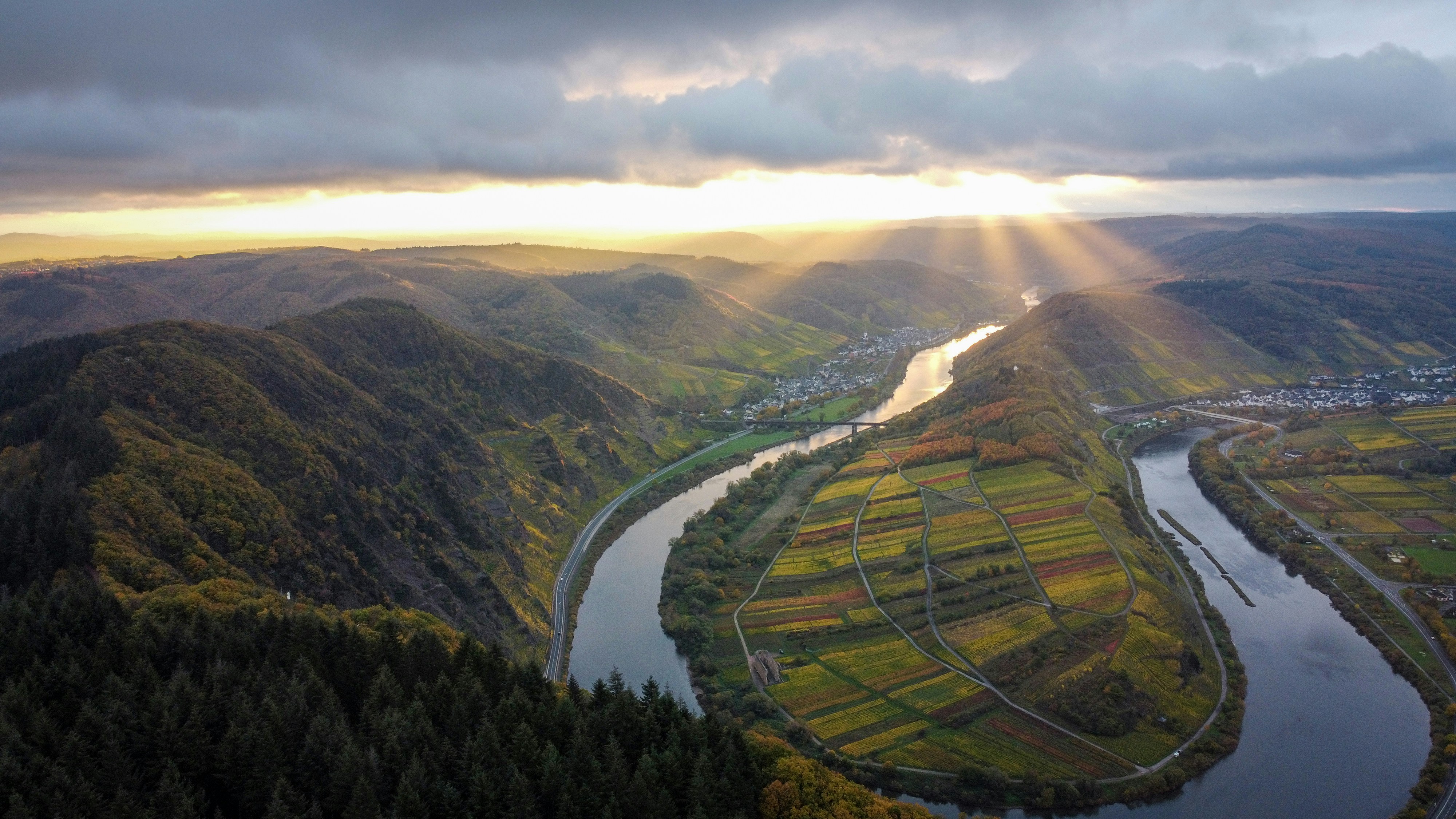
A country where river valleys, steep slopes, cool light, and patient ripening shaped one of Europe’s most distinctive vine cultures: Germany is one of the great northern vineyard landscapes of the world, marked by slate hillsides, loess and limestone soils, river bends, forest edges, and a remarkable ability to translate cool-climate nuance into grape identity. From the Mosel to Rheinhessen, from Baden to Franken and the Nahe, it offers not one wine style but a set of finely tuned regional voices rooted in site, precision, and long viticultural memory.
In Germany, grapes seem to learn patience from rivers, slopes, and long seasons. They ripen through cool light, mist, stone, and the kind of tension that makes place feel etched into the wine before it is ever named.
Contents
Overview
Overview
Germany is one of the great cool-climate vine countries of Europe, and its importance rests on far more than one famous grape. What makes Germany compelling is the way viticulture developed in often marginal or difficult settings and turned those conditions into strengths. River valleys, steep slopes, reflective light, cool temperatures, and long ripening seasons all helped create a vineyard culture where patience, balance, and site sensitivity became central.
Germany is frequently introduced through Riesling, and rightly so, but the country’s identity is broader than that one brilliant lens. Alongside Riesling stand Silvaner, Spätburgunder, Müller-Thurgau, Weissburgunder, Grauburgunder, Lemberger, and a number of regional and historically rooted varieties that contribute to a more layered picture. Modern German wine has also changed significantly, with far greater attention to dry styles, regional distinction, and vineyard expression than older export stereotypes alone would suggest.
For Ampelique, Germany matters because it reveals how grapes behave at the edge of ripening comfort. It shows how climate pressure, slope, and exposure can clarify identity, and how a country can build one of the world’s most refined vineyard cultures not in warmth and abundance, but in precision and restraint.
Landscape
Climate & geography
Germany’s vineyard geography is shaped above all by rivers, slopes, and latitude. The Rhine and its tributaries, together with the Mosel, Nahe, Main, Neckar, and other river systems, create corridors where viticulture became possible and often remarkable. Water moderates temperature, reflective light assists ripening, and south-facing slopes can turn otherwise cool settings into highly expressive vineyard sites.
The country’s climates are not uniform. Some areas are clearly cooler and more river-bound, while others, especially in the southwest, are warmer and more open to broader European influences. Soil variation also matters greatly: slate in the Mosel, loess and limestone in Rheinhessen and parts of Franken, sandstone, volcanic traces, marl, quartzite, and many mixed local subsoils all help explain why German wines can differ so strongly from one region to the next.
Some of Germany’s most memorable vineyard images come directly from this geography: the impossibly steep Mosel slopes, the broad rolling sites of Rheinhessen, the river bends of the Rheingau, the shell-limestone and distinctive bottle culture of Franken, the warmer and more expansive zones of Baden, and the forest-edged sites of the Pfalz. Together they show that Germany is not one cool-climate story repeated, but a family of landscapes each tuned to its own pace of ripening.
Grape heritage
Grape heritage
Germany’s grape heritage is often summarized through Riesling, but that is only the beginning. Riesling may be the most internationally recognized expression of German viticulture, yet the country also has a long and meaningful history with Silvaner, Spätburgunder, Müller-Thurgau, Weissburgunder, Grauburgunder, Kerner, Trollinger, Lemberger, and a range of local and regional traditions that deserve equal attention in a broader archive.
One of Germany’s strengths lies in the way varieties have often been preserved through regional habit rather than only through fashion. Some grapes stayed important because they suited particular climates or soils; others because they fitted local food culture, ripening patterns, or cellar traditions. Even where modern plantings have shifted, the country still offers an unusually clear view of how cool-climate grape identity evolves through practical continuity.
For Ampelique, Germany matters because it expands the idea of grape significance beyond heat-loving prestige grapes. It helps show how whites, lighter-framed reds, and subtle site-responsive varieties can become profound when the climate rewards patience and nuance rather than force.
Important regions
Important regions
- Mosel – one of the world’s most distinctive cool-climate vineyard landscapes, especially important for slate-grown Riesling.
- Rheingau – historically central, river-shaped, and one of the classic homes of fine German Riesling.
- Rheinhessen – broad, diverse, and increasingly important for both classic and modern German expressions.
- Pfalz – warmer and more open in style, yet still deeply tied to German varietal identity and regional nuance.
- Baden – a key region for Spätburgunder and a wider range of warmer-climate German expressions.
Many other regions deserve close attention: Franken for Silvaner and shell-limestone identity, Nahe for remarkable geological variety, Württemberg for distinctive red traditions, Ahr for Spätburgunder, and Saale-Unstrut or Sachsen for more northerly viticultural edges. But these five provide a strong first route into Germany’s broader grape map.
Styles
Wine styles
Germany produces one of Europe’s most refined spectra of cool-climate wine styles. It is known for Riesling in dry, off-dry, and sweet forms, but that only begins to describe the country. Germany also produces elegant Spätburgunder, textural white Burgundian varieties, Silvaner of quiet depth, sparkling wines, and regional styles that range from feather-light to surprisingly structured and age-worthy.
Older export images focused heavily on sweetness, but modern Germany is far more varied and often much drier in emphasis. Today the country is best understood not through one style stereotype, but through a set of regional and varietal possibilities: slate-driven tension, loess and limestone breadth, red-fruited delicacy, floral lift, and long, acid-shaped ageing potential. Germany is a country where subtle differences remain highly visible in the glass.
Even within a single grape, Germany can offer many voices. Riesling alone changes dramatically between Mosel, Rheingau, Nahe, Rheinhessen, and Pfalz. Spätburgunder shifts according to warmth, soil, and region. Silvaner becomes especially revealing in Franken. This internal variety is part of what makes Germany so useful on Ampelique: it shows how climate, geology, and ripening pace remain audible in the grape itself.
Signature grapes
Signature grapes
- Riesling – Germany’s defining grape and one of the most site-sensitive white varieties in the world.
- Spätburgunder – Pinot Noir in its German form, increasingly central to the country’s red identity.
- Silvaner – especially meaningful in Franken and one of Germany’s quietly great white grapes.
- Weissburgunder – an important white grape in modern Germany, often showing clarity and textural restraint.
- Grauburgunder – widely planted and regionally expressive in warmer settings.
- Lemberger – one of the country’s more distinctive red grapes, especially meaningful in Württemberg.
Many others deserve close attention: Müller-Thurgau, Kerner, Trollinger, Scheurebe, Frühburgunder, and further regional or historic material across the country. But these six offer a strong first constellation for understanding Germany through grape identity rather than through one single icon.
Why it matters
Why Germany matters on Ampelique
Germany matters because it shows how greatness in the vineyard can emerge from restraint, precision, and climatic tension rather than from abundance or dramatic warmth. It is one of the strongest countries for understanding how river valleys, slopes, and long seasons shape a grape’s inner line. It also widens the map of importance beyond the warmer wine countries that usually dominate casual wine conversation.
For Ampelique, Germany is a country of patience, clarity, and cool-climate identity. It helps reveal how a grape archive can become a map of ripening thresholds, geological nuance, and regional discipline. It is one of the places where subtlety becomes fully visible.
Where to start
Where to start exploring
If you want to begin exploring Germany, start with contrast. Read Mosel beside Baden, Rheingau beside Franken, a steep slate valley beside a broader loess or limestone region, a dry Riesling beside a Spätburgunder or Silvaner. Compare river-shaped coolness with warmer southwestern breadth, and one grape region against another. Germany becomes clearer when read through its gradients rather than through a single grape alone.
A second good route is to begin with the varieties. Follow Riesling, Spätburgunder, Silvaner, Weissburgunder, Grauburgunder, or Lemberger into their home landscapes. Germany opens through the grapes, but those grapes nearly always point back to slope, river, and ripening season.
Reference sheet
Quick facts for grape geeks
| Field | Details |
|---|---|
| Country | Germany |
| Continent | Europe |
| Main climate influences | Cool continental, river-moderated, southwestern warmth, forest-edge and slope influences |
| Key vineyard landscapes | Steep slate slopes, river valleys, loess and limestone hills, broader inland vineyards, warmer southwestern zones |
| Known for | Riesling, cool-climate precision, steep-slope viticulture, and long ripening nuance |
| Important grape colors | Strong white identity, but also increasingly significant red varieties |
| Notable native or deeply rooted grapes | Riesling, Silvaner, Spätburgunder, Weissburgunder, Grauburgunder, Lemberger, Müller-Thurgau, Kerner |
| International grapes present | Some French-origin grapes are well established, but Germany remains defined by its own cool-climate adaptation and regional identity |
| Best starting point | Begin with Mosel, Rheingau, Rheinhessen, Pfalz, and Baden |
| Archive link | Germany |
 Ampelique