Understanding Germany: Wine Heritage, Native Grapes, Regions, and Viticultural Identity
A country of river valleys, steep slopes, long ripening seasons, and wines shaped as much by light and latitude as by grape variety: Germany is one of Europe’s most distinctive vineyard landscapes, known for Riesling, Spätburgunder, and a remarkable range of white and red wines grown across 13 official wine regions. From the slate terraces of the Mosel to the limestone and loess of Baden, the broad hills of Rheinhessen, the sheltered warmth of the Pfalz, and the Riesling heartland of the Rheingau, Germany offers a wine culture rooted in precision, freshness, and an unusually clear dialogue between grape, slope, soil, and climate.
Germany does not speak through weight. It speaks through slope, river, stone, cool light, and the long patience of grapes that ripen slowly enough to remember where they grew.
Overview
Germany is one of the world’s most distinctive cool-climate wine countries, yet it is often reduced too quickly to a single image: Riesling. Riesling is indeed central, and rightly so, but Germany is more varied than that. Officially there are 13 wine-growing regions, spread across river valleys, sheltered slopes, warmer southern corridors, and some of the northernmost serious vineyard sites in Europe. Together they form a wine culture of remarkable detail rather than sheer scale.
One of Germany’s most interesting traits is the balance between continuity and evolution. The country has long been associated with white wines, and that remains true: roughly two-thirds of vineyard area is planted to white grapes, with the remaining third red. Yet Germany is also one of the world’s important homes for Spätburgunder, and regions such as the Ahr, Baden, and parts of the Pfalz and Rheinhessen have shown how strongly red wine can belong here too.
For Ampelique, Germany matters because it is one of the clearest places to understand how climate, slope, and ripening rhythm shape the vine. Here, terroir is not only about prestige sites. It is often visible in the practical struggle for sun, heat, and exposure. The result is a wine culture built on precision, acidity, transparency, and the patient translation of place.
Climate & geography
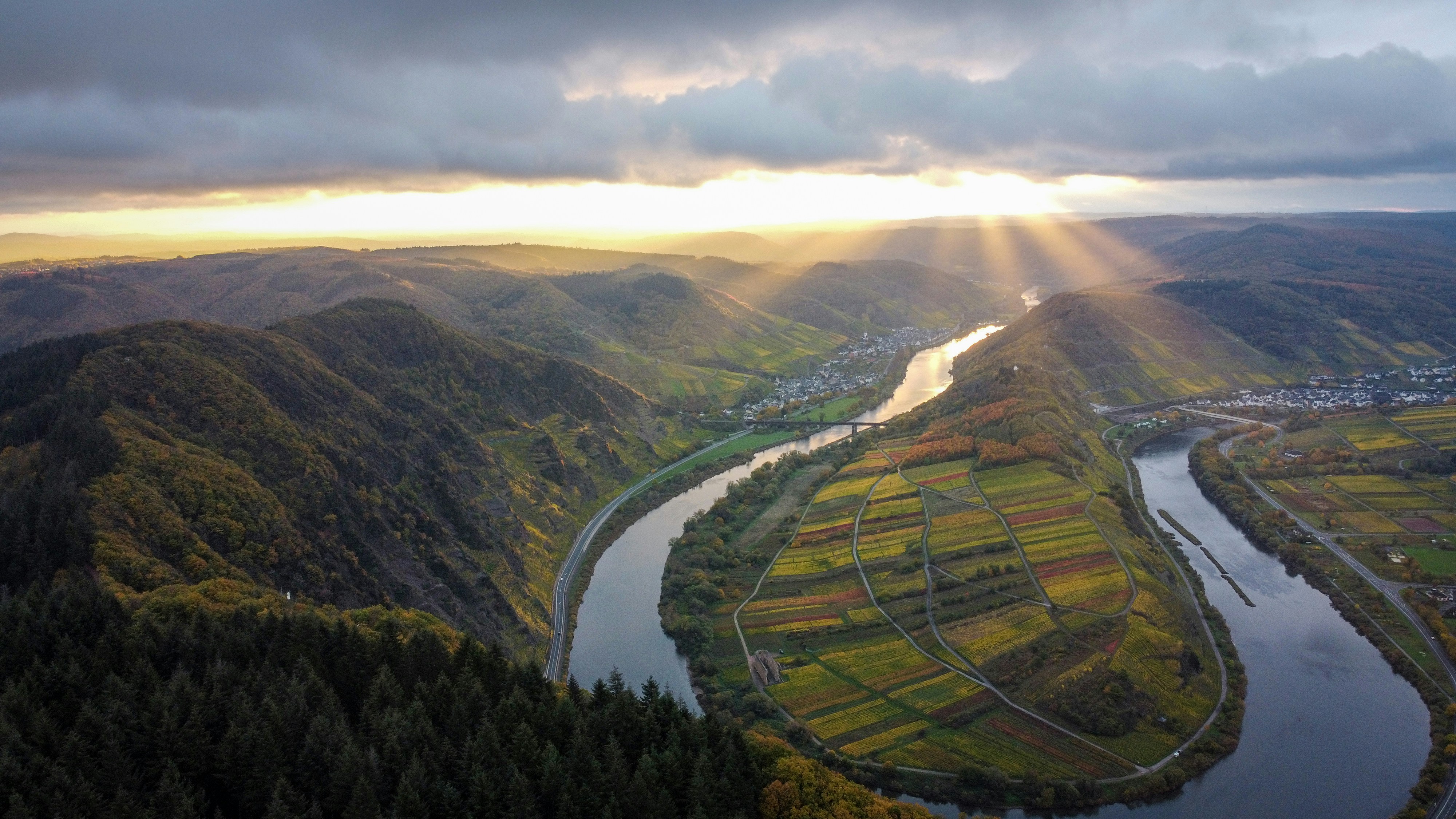
Germany’s vineyard geography is one of river valleys, steep slopes, broad hill country, and sheltered corridors of warmth. The rivers are especially important. The Rhine, Mosel, Nahe, Main, Ahr, and their tributaries do more than make the landscape beautiful. They reflect light, moderate temperature, and carve out vineyard exposures that can help grapes ripen in a relatively cool continental setting.
In the Mosel and Mittelrhein, steep terraced slopes become a central feature of viticulture. In the Rheingau, south-facing sites along the Rhine create one of Germany’s great Riesling environments. In Rheinhessen, the landscape opens into gentler, broader hills. The Pfalz benefits from the protection of the Pfälzerwald forest and a warmer, more generous climate. Baden stretches for hundreds of kilometers from north to south and includes a surprisingly broad range of conditions. Franconia brings limestone and keuper soils along the Main, while the Ahr shows how a small, northern river valley can become a distinguished red-wine landscape.
This diversity matters because Germany is often misunderstood as uniformly cold. In reality, it contains many microclimates and many viticultural solutions. Steep slopes gather heat. River valleys reduce extremes. Sheltered regions ripen more fully. Cool nights preserve acidity. The country’s wine identity is therefore not built on warmth alone, but on the successful management of light, slope, and season.
Grape heritage
Germany cultivates more than 100 grape varieties across just over 103,000 hectares of vineyard area, a combination that reveals both diversity and specialization. Internationally, Germany is especially important because it is the world leader in Riesling and Pinot Blanc cultivation and ranks among the leading countries for Pinot Noir and Pinot Gris as well. That alone says something important: Germany is not a one-grape country, even if Riesling remains its clearest emblem.
Riesling is central because it expresses site so clearly and thrives in the long, cool ripening season that Germany can offer. The grape reaches extraordinary precision on slate, quartzite, limestone, loess, or mixed soils, and can appear in styles from dry to nobly sweet. But Germany’s grape heritage also includes Spätburgunder, whose rise has made the country one of the most serious red-wine producers in northern Europe. Silvaner remains deeply rooted in Franconia and is also important in Rheinhessen. Müller-Thurgau, once seen mainly as a productive crossing, still plays a meaningful role in several regions. Grauburgunder and Weißburgunder have become increasingly important, especially in drier, food-friendly styles.
Regional grapes also give Germany texture beyond the famous names. Trollinger and Lemberger still matter in Württemberg. Frühburgunder remains a specialty in the Ahr. Elbling continues in the Mosel area. PIWI varieties are increasingly part of the conversation as well. This makes Germany especially rewarding for Ampelique: it combines benchmark grapes with regional character and an evolving, technically alert viticulture.
Important regions
- Mosel – one of Germany’s oldest wine regions, famed for steep slate slopes and refined Riesling along the Mosel, Saar, and Ruwer rivers.
- Rheingau – one of the country’s classic Riesling strongholds, with a very high share of Riesling on dry, stony, south-facing slopes.
- Rheinhessen – Germany’s largest wine region, a broad landscape of rolling hills, diverse soils, and both classic and modern styles.
- Pfalz – the second-largest region, protected by the Pfälzerwald and notable for Riesling, Burgundian varieties, and a comparatively sunny climate.
- Baden – a long north-south region with warmer conditions, important for Spätburgunder, Grauburgunder, and Weißburgunder.
Other regions complete the picture in essential ways. Franconia is crucial for Silvaner and its limestone-keuper identity. The Ahr is one of Germany’s great red-wine landscapes, especially for Spätburgunder and Frühburgunder. Württemberg is the country’s most red-dominant major region and preserves grapes such as Trollinger and Lemberger. Nahe, Saale-Unstrut, Sachsen, Mittelrhein, and Hessische Bergstraße all add further detail to the German map. The strength of Germany lies not in one dominant style, but in the coherence of many regional voices.
Wine styles
Germany produces a wider range of styles than many people expect. Dry wines are now central to the country’s modern identity, especially in regions such as the Pfalz, Rheinhessen, Baden, and parts of the Rheingau and Nahe. But Germany also remains one of the few countries where residual sweetness can still be used with real precision and dignity, especially in Riesling. Kabinett, Spätlese, Auslese, and nobly sweet wines continue to show how sweetness, acidity, and terroir can work together rather than cancel one another out.
Alongside these white styles, Spätburgunder has become one of Germany’s most important success stories. In the Ahr, Baden, and beyond, it can produce reds of finesse, freshness, and growing depth. Grauburgunder and Weißburgunder contribute food-friendly dry whites with broader texture. Silvaner can be subtle, stony, and quietly profound, especially in Franconia. Sekt remains an important category too, and Germany’s base-wine culture gives sparkling production real substance.
This breadth is one of Germany’s great strengths. It can produce wines of low alcohol and crystalline acidity, structured dry reds, noble sweet wines, Blanc de Noir, and serious sparkling wines without feeling stylistically incoherent. The country’s unity lies in clarity, freshness, and the persistent influence of site.
Signature grapes
- Riesling – Germany’s defining white grape, capable of dry, off-dry, sweet, and noble sweet wines of remarkable site expression.
- Spätburgunder – Germany’s great red grape, especially important in the Ahr, Baden, Pfalz, and Rheinhessen.
- Silvaner – a key grape of Franconia and an important part of Germany’s quieter, terroir-driven white-wine tradition.
- Müller-Thurgau – an early-ripening crossing that still plays a meaningful role in several German regions.
- Grauburgunder – one of Germany’s major Pinot-family grapes, often giving dry wines of texture and breadth.
- Weißburgunder – an increasingly important white grape valued for elegance, discretion, and food-friendly freshness.
Other names deserve attention too: Trollinger and Lemberger in Württemberg, Frühburgunder in the Ahr, Elbling in the Mosel area, and a growing number of fungus-resistant PIWI varieties. But these six form a strong first path into Germany as a wine country of both classic reference points and regional nuance.
Why Germany matters on Ampelique
Germany matters because it demonstrates how clearly the vine can respond to cool climates, long ripening seasons, and difficult topography. It is one of the best places to understand the relationship between acidity and site, between river valleys and heat retention, between slope and exposure, between sweetness and structure. Germany shows that elegance is not the absence of intensity, but one of its most demanding forms.
For Ampelique, Germany is essential because it turns viticulture into topography you can almost read with your eyes. Steep slate vineyards, broad hill country, south-facing river bends, and stony slopes are not background scenery here. They are part of the grammar of the wines. Germany reminds us that a grape library is also a landscape library.
Where to start exploring
If you want to begin exploring Germany, start with contrast. Read Mosel beside Baden, Rheingau beside the Ahr, Rheinhessen beside Franconia. Compare steep slate Riesling with limestone Silvaner, a dry Pfalz Riesling with a lighter Mosel style, a Spätburgunder from the Ahr with one from Baden. Germany becomes much clearer when you stop seeing it as one Riesling country and begin reading it as a set of regional climates and viticultural solutions.
You can also begin through grape families. Follow Riesling through Mosel, Rheingau, Pfalz, and Nahe. Follow the Pinots through Baden, Pfalz, and Rheinhessen. Follow Silvaner into Franconia. Follow Spätburgunder into the Ahr. In Germany, the grape is often the first key, but the slope, river, and soil complete the meaning.
Quick facts for grape geeks
| Field | Details |
|---|---|
| Country | Germany |
| Continent | Europe |
| Main climate influences | Cool continental, river-valley, sheltered slope, and warmer southern corridor influences |
| Key vineyard landscapes | Steep slate slopes, river terraces, rolling hills, limestone and loess zones, broad southern vineyard belts |
| Known for | Riesling, Spätburgunder, cool-climate precision, steep-slope viticulture, noble sweet wines, dry whites, and growing red-wine quality |
| Important grape colors | Predominantly white, with a significant and increasingly respected red-wine sector |
| Notable native grapes | Riesling, Spätburgunder, Silvaner, Müller-Thurgau, Grauburgunder, Weißburgunder, Trollinger, Lemberger |
| International grapes present | Chardonnay, Sauvignon Blanc, Merlot, Cabernet Sauvignon, Cabernet Franc, and others in selected regions |
| Best starting point | Begin with Mosel, Rheingau, Rheinhessen, Pfalz, and Baden, then move to Franconia, the Ahr, Nahe, and Württemberg |
 Ampelique