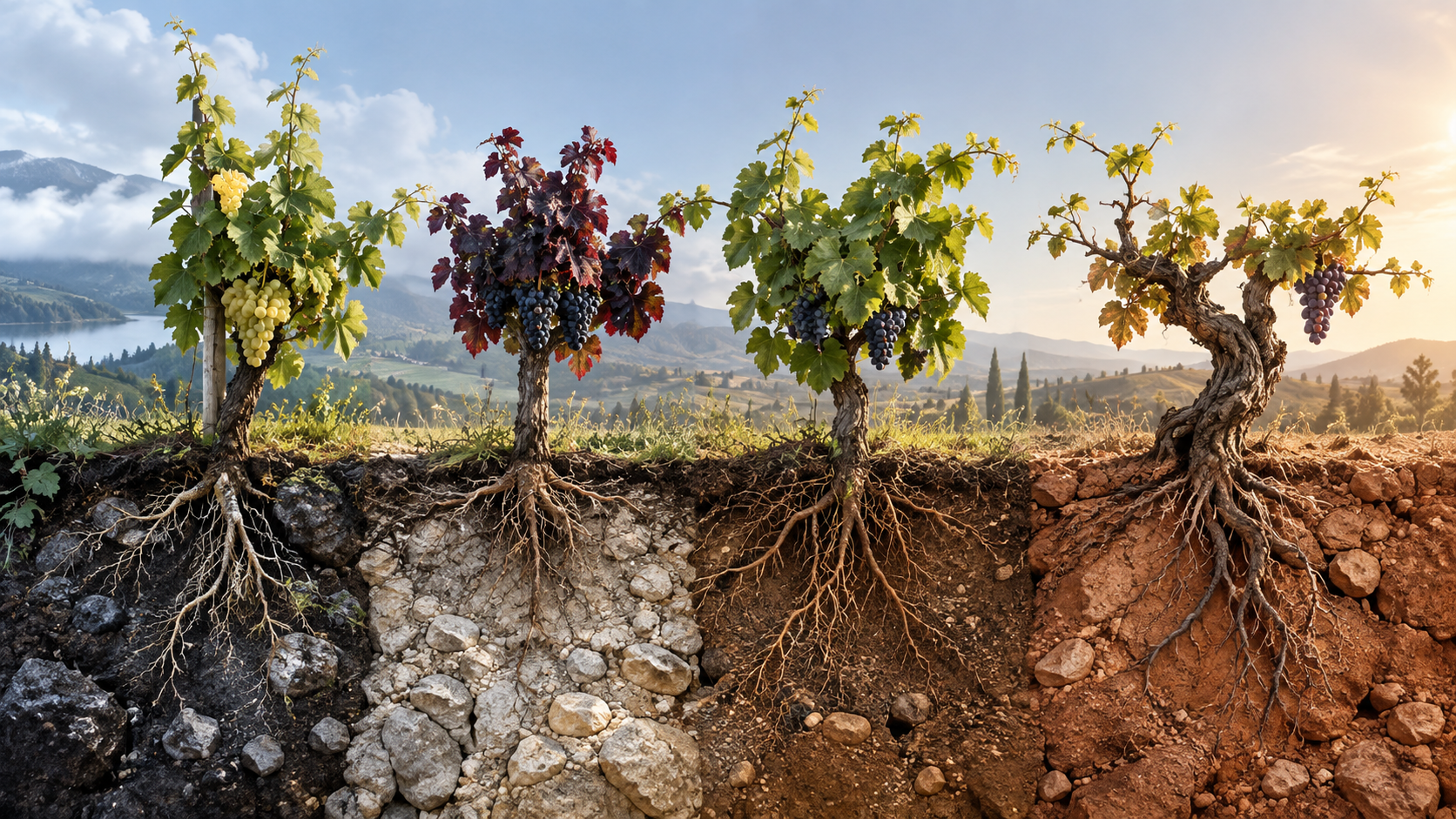
Not Every Grape Belongs Everywhere
A grape variety may be able to grow in many places, but that does not mean it will perform equally well in all of them. Each variety has its own rhythm and its own way of responding to temperature, water and the length of the growing season. That helps explain why certain grapes have become closely associated with particular regions.
Timing matters
One of the biggest differences between grape varieties is timing. Some begin their growing cycle early, while others start later. The same is true for flowering, veraison and ripening.
An early-budding variety can be more exposed to spring frost if warm weather encourages the buds to open before the danger has passed. A late-ripening variety faces a different challenge: it needs enough warmth and enough time to reach maturity before the growing season ends.
This is one reason why varieties that work well in one region may struggle in another.
Water changes the picture
Grapevines also differ in the way they respond to water shortage. Some varieties reduce water loss more readily under dry conditions, while others follow different physiological strategies.
But these differences are not as simple as dividing grapes into drought-tolerant and drought-sensitive groups. The response of a vine also depends on the severity of the drought, temperature, soil, rootstock and vineyard conditions.
What works well in one place may therefore be less successful somewhere else.
Heat changes the rhythm
Temperature has a powerful influence on grapevine development. Warmer conditions generally accelerate the growing cycle and can bring ripening and harvest forward.
That can be beneficial in a cool region where a variety once struggled to ripen. Too much heat, however, can create other problems. Sugar may accumulate rapidly while acidity falls, and extreme heat can place additional stress on both vine and fruit.
Varieties with later ripening cycles can sometimes offer advantages in warmer conditions because their development is naturally shifted later in the season. But no grape variety is automatically protected against heat or drought.
Finding the right match
This is why choosing the right grape for the right place matters.
Climate is only part of the equation. Soil, altitude, slope, water availability, rootstock and vineyard management all influence how a vine performs. Growers can adjust pruning, canopy management, irrigation and harvest timing, but the characteristics of the variety remain an important starting point.
And that match is becoming increasingly important. As growing conditions change, wine regions are exploring later-ripening varieties, locally adapted grapes, different rootstocks and other plant material that may be better suited to future conditions.
A successful vineyard is therefore not simply about finding a grape that can grow there. It is about finding a variety whose natural rhythm fits the conditions of the place.
That relationship between grape and place is one of the foundations of viticulture.
Leave a Reply